

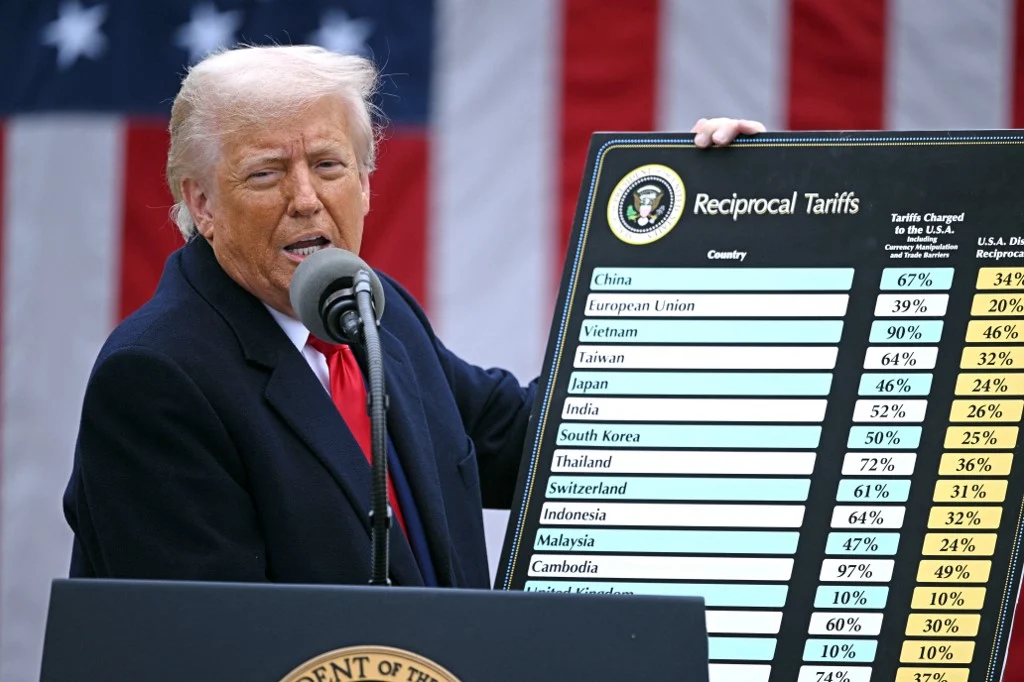
The announcement marks a swift escalation in the administration’s conflict with the judiciary, invoking a different legal authority to impose a temporary 150-day tariff immediately following the Supreme Court’s rejection of the president’s powers under a 1977 economic emergency act, according to AFP.
Writing on his Truth Social platform, Trump stated that the administration conducted a review of the court’s “extraordinarily anti-American decision.”
Consequently, the administration decided to raise import levies “to the fully allowed, and legally tested, 15% level,” replacing an initially proposed 10 percent figure.
The Supreme Court’s 6-3 ruling on Friday represented a significant rebuke to the president, striking down a signature economic policy that has disrupted the global trade order.
In response, Trump launched a personal attack on the conservative justices who sided with the majority, labeling them “fools” and criticizing their “disloyalty.”
Under the new order, the 15% duty is legally designated as temporary. According to a White House fact sheet, exemptions remain for sectors currently under separate investigations, such as pharmaceuticals, as well as goods entering under the US-Mexico-Canada Agreement (USMCA). However, trading partners that had previously reached separate deals with the administration will now face this new global tariff.
Read more: US Supreme Court halts Trump tariffs, ruling president exceeded authority
International reaction to the sudden policy shift has been swift. German Chancellor Friedrich Merz announced he would hold talks with European allies to formulate a joint position before traveling to Washington in March. Meanwhile, leaders in the Southern Hemisphere expressed concern over global stability.
“I want to tell the US President Donald Trump that we don’t want a new Cold War. We don’t want interference in any other country, we want all countries to be treated equally,” Brazilian President Luiz Inacio Lula da Silva told reporters in New Delhi.
Domestically, the move has drawn criticism from state leaders concerned about economic fallout. Pennsylvania Governor Josh Shapiro stated it was time for the president to “listen to the Supreme Court, end chaotic tariffs, and stop wreaking havoc on our farmers, small business owners, and families.”
While business groups such as the National Retail Federation had initially cheered the Supreme Court ruling for providing “much-needed certainty,” the administration’s countermove has reintroduced unpredictability.
Furthermore, the court’s ruling did not address whether companies would receive refunds for tariffs deemed unlawful, a process Justice Brett Kavanaugh noted could become a “mess.”
Government probes currently underway could lead to additional sectoral tariffs beyond the new global duty. Trump acknowledged the likelihood of prolonged legal battles regarding refunds, suggesting the uncertainty surrounding US trade policy will continue for the foreseeable future.


