

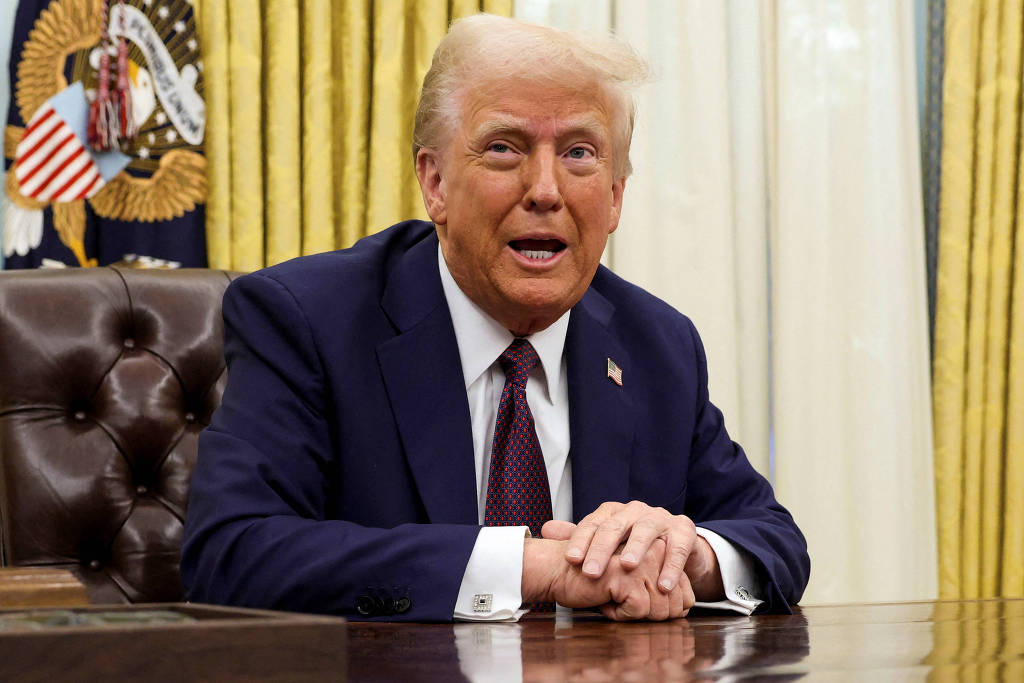
On Sunday, the President of the United States stated that the country urgently needs Greenland, reigniting tensions between Washington, Greenland, and Denmark. Greenland is part of the Kingdom of Denmark, which previously administered it as a colony and continues to control its foreign and security policy.
Danish Prime Minister Mette Frederiksen warned that a US attack on a NATO ally, in this case Greenland as part of Denmark, would mean the end of the Atlantic Alliance. Greenlandic Prime Minister Jens-Frederik Nielsen urged Trump to abandon what he called “annexation fantasies,” while several European leaders expressed support for Copenhagen and Nuuk, emphasizing that “Greenland belongs to its people.”
Despite the reactions, Stephen Miller, one of Trump’s top advisors, assured that the US administration is determined to acquire Greenland and believes it can do so without resorting to military intervention.
Why is Donald Trump so fixated on Greenland?
Greenland has been on Trump’s agenda for several years, although the justifications presented have evolved over time. In 2019, during his first term, Trump confirmed reports that he asked his advisors to analyze the possibility of the United States buying the island, describing the operation as “essentially a big real estate deal.” In January of last year, already as President-elect, he stated that he needed to control Greenland for reasons of “economic security.” In recent days, however, he has begun to invoke arguments of “national security,” despite the impact such a position could have on the future of NATO.
Strategically located between the United States and Russia, Greenland is increasingly seen as a key territory for defense, emerging as a new stage for geopolitical competition as the climate crisis worsens.
Beyond oil and gas, Greenland possesses significant reserves of raw materials essential for green technologies, including lithium, cobalt, and rare earth elements. These resources have sparked global interest, particularly from China, which dominates the world’s production of rare earth elements and has threatened to restrict the export of critical minerals. A potential acquisition of Greenland would allow the United States to limit Chinese access to these resources.
The rapid melting of the Arctic is also opening new maritime routes, which could reduce travel time between Western Europe and East Asia by almost half. In November, China and Russia agreed to cooperate in the development of these new Arctic shipping routes.
The United States already maintains a strategic military presence on the island, notably at the Pituffik base (formerly Thule), a central element of the US early warning system against ballistic missiles.
What does Denmark have to do with this?
Inuit peoples have lived in Greenland for several thousand years. The territory was later reached by Norse navigators and, in the 18th century, was formally colonized by Denmark-Norway. During World War II, when Denmark was occupied by Nazi Germany, Greenland was occupied by the United States, being returned to Copenhagen in 1945.
Greenland officially became part of the Kingdom of Denmark in 1953 and gained autonomy in 1979. It has its own parliament, the Inatsisartut, and elects two members to the Danish parliament, the Folketing, but foreign policy and defense remain under Danish control.
Relations between Denmark and Greenland have deteriorated in recent years, particularly following investigations into the forced imposition of intrauterine devices on Greenlandic women and girls in the 1960s and 1970s, as well as the separation of Greenlandic children from their families. Denmark has since issued an official apology and agreed to compensate the victims, in an attempt to repair relations amid growing support for independence.
How are Greenland and Denmark reacting to Trump’s attacks?
Mette Frederiksen took a firm stance, warning that any military action by the United States against a NATO ally would put an end to the post-World War II security architecture. “If the United States decides to militarily attack another NATO country, everything ends—including NATO,” she stated in an interview with Danish television channel TV2.
Jens-Frederik Nielsen unequivocally rejected American pressure, arguing that “threats, intimidation, and talks of annexation have no place between friends.” In his New Year’s address, King Frederik praised the “strength and pride” of the Greenlandic people during a period he described as “turbulent.”
Faced with increasing external pressure, Greenland’s political parties formed a four-party coalition government in March as a demonstration of national unity. The first sentence of the coalition agreement was clear: “Greenland belongs to us.”
According to the agreement signed with Denmark in 2009, Greenland can only declare independence after holding and approving a referendum, a step that now takes on new geopolitical weight in light of Trump’s renewed ambitions in the Arctic.
