

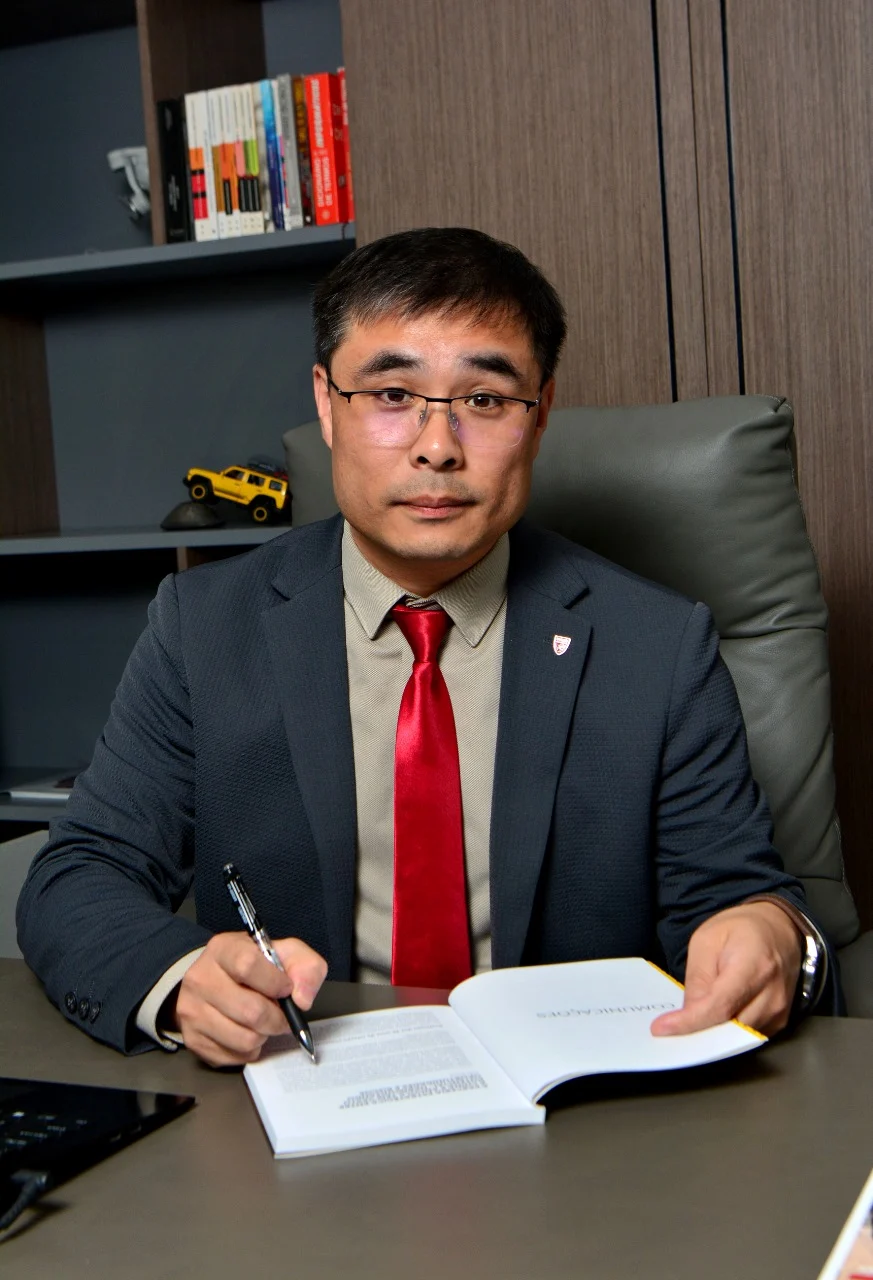
How does Beijing view the PALOP within its broader relationship with Africa?
João Shang — China has made efforts to build good relations with all African countries, and naturally that includes the six Portuguese-speaking African nations. Although the economic weight of the PALOP is not very large, China aims to maintain a long-term friendship. Among the PALOP, Angola, Mozambique, and Equatorial Guinea are currently China’s most important trading partners, due to their high volume of trade; Cape Verde and São Tomé and Príncipe stand out as tourist destinations for Chinese travelers; and political relations with Guinea-Bissau remain excellent at the international level.
Given the expansion of the BRICS and China’s role in that process, do you see room for the PALOP — particularly Angola — to join in the near future?
J.S. — Today’s world is diverse; the unipolar world has disappeared forever. Therefore, it is necessary to cultivate a culturally and politically diverse atmosphere, especially among countries of the Global South, whether developing or underdeveloped. The emergence of the BRICS meets the expectations of many of these countries, which seek to gain more benefits and support through this platform.
In reality, the role of the BRICS is very different from that of Western alliances. It is not a military entity, but rather an economic mechanism in which all members have equal rights. There is no leader controlling the BRICS — China, India, and South Africa have equivalent standing. Therefore, one cannot say that China is the “leader” of the BRICS.
At present, South Africa is seeking to attract more African countries to the group. Ethiopia and Egypt became official members on January 1, 2024. Furthermore, following the 2023 summit, countries such as Zimbabwe and Algeria expressed interest in joining, although they have not yet done so. The Portuguese-speaking African countries would need to formally submit their applications.
In recent years, the Angolan government has drawn closer to the United States, while its relationship with Russia has not been good. It seems to me, therefore, that Angola would first have to convince Moscow to support its entry. China, on the other hand, continues to stand by Angola. In 2024, the two countries signed the Joint Declaration on the Establishment of the Comprehensive Strategic Cooperation Partnership, a highly significant agreement that strengthens bilateral ties.
Do you think that a possible federalization or stronger political integration of the PALOP would make them more attractive partners for China?
J.S. — On the world stage, the PALOP do not constitute an economic or military power comparable to other regional blocs, but they hold significant cultural, linguistic, and geopolitical value. Angola and Mozambique stand out as the group’s largest economies, mainly due to oil, natural gas, coal, and other strategic minerals. Cape Verde and São Tomé and Príncipe, despite their small size, have strategic importance because of their Atlantic location, serving as logistical and maritime security hubs.
Politically, the countries in the group participate actively in the African Union and the United Nations, often in a coordinated manner. Angola has played an important role in mediating regional conflicts, while Cape Verde stands out as an example of democratic stability in Africa.
Thus, China sees increasing opportunities for cooperation with the PALOP, especially in the import of raw materials and in the agricultural sector. There is therefore much room to expand cooperation.
Angola is China’s second-largest Portuguese-speaking trading partner, after Brazil, but its exports to Beijing have been declining. What factors explain this drop, and how could Angola diversify its exports beyond oil?
J.S. — Angolan exports to China are expected to fall by around 17% in 2025, mainly because Beijing has diversified its oil suppliers, favoring countries such as Russia and others in the Middle East, with lower prices and transport costs. Thus, the decline in Chinese purchases of Angolan oil is not surprising.
Furthermore, Angola is currently going through a difficult economic period. The shortage of foreign currency, cuts in subsidies, devaluation of the currency, rising oil prices, and inflation have reduced domestic purchasing power, also leading to a drop in imports from China.
Since 2014, the Angolan government has been trying to diversify the economy, aware of the risks of the so-called “Dutch disease” [In economics, Dutch disease refers to the relationship between the export of natural resources and the decline of the manufacturing sector]. Agricultural, mining, industrial, and tourism projects have been promoted to reduce dependence on oil. However, the economic reform has proven to be a demanding test for the entire government system, requiring strong interministerial coordination.
Eleven years later, oil remains the backbone of the economy, given its high profitability and lower investment costs compared to other sectors. There have been investments in agriculture and mining, but with limited results. The government has urged provinces to attract more investment, but the challenging business environment has deterred Western investors. Chinese companies, on the other hand, have mainly focused on construction and trade, creating jobs and, more recently, investing in local factories, which generates opportunities for Angolan youth.
Angola has historical ties with Russia and is also exploring partnerships with the European Union. How does China handle Angola’s multi-vector diplomacy?
J.S. — First of all, China follows a policy of non-interference in the internal affairs of other countries, recognizing that the Angolan government has the right to choose its own partners. Currently, relations between Angola and Russia are developing, but not as solidly as might be expected. Divergent interests have led to distinct and even conflicting approaches, with each side pursuing its own agenda.
Since 2017, Angola has been seeking Western funding and support. However, much of this support has not materialized in practice. One example is the Lobito Corridor: after the United States abruptly announced that it would not participate in the project, Angola was forced to seek assistance from Arab countries, Israel, South Korea, and the African Development Bank.
How effective has investment and trade promotion via the Macau Forum been, particularly for smaller economies such as São Tomé and Príncipe or Guinea-Bissau?
J.S. — One of the key roles of the Macau Forum is to deepen economic and trade cooperation. It has promoted bilateral investment, trade facilitation, and partnerships in strategic sectors such as energy, infrastructure, agriculture, fisheries, and finance. In addition, initiatives such as the China–Portuguese-Speaking Countries Cooperation and Development Fund support concrete development projects.
The Forum also plays an important role in cultural and human exchange. Through training and capacity-building programs, it promotes knowledge transfer and strengthens relationships between professionals and institutions. Macau, with its Sino-Lusophone heritage and official use of the Portuguese language, serves as a privileged meeting point in this dialogue.
As the only city in China where Portuguese is an official language, Macau can serve as a bridge between China and the PALOP. The Macau Forum, in coordination with the CPLP, constitutes a strategic platform for exchange and cooperation, where the shared language strengthens trust and closeness among members. In short, the Macau Forum is much more than an economic platform: it is a strategic bridge that promotes political trust, joint development, and cultural proximity between China and the Portuguese-speaking world.
Given the most recent statistics showing a decline in PALOP exports to China, do you expect Beijing to adjust its policies or its financing instruments, such as the China–Portuguese-Speaking Countries Cooperation and Development Fund?
J.S. — China has an interest in maintaining strong trade relations with the PALOP, both to ensure the supply of raw materials (oil, minerals, etc.) and to expand access to new consumer markets.
In 2023, the Sino-Lusophone Fund eased its financing access rules, allowing more Lusophone companies to use its credit lines. This trend could translate into more capital, more accessible loans, or more favorable financial conditions (interest rates, terms, guarantees) for export or production projects in the PALOP.
The goal is also to encourage producer countries to add value to their products, exporting not only raw materials but also processed goods with higher added value. Another line of action involves supporting port, infrastructure, and customs reforms, reducing tariffs and non-tariff barriers that still hinder African exports.
Since the 2025 Forum on China–Africa Cooperation, Beijing has granted tariff exemptions on 90% of products originating from African countries, meaning the PALOP can benefit significantly from this measure.
