

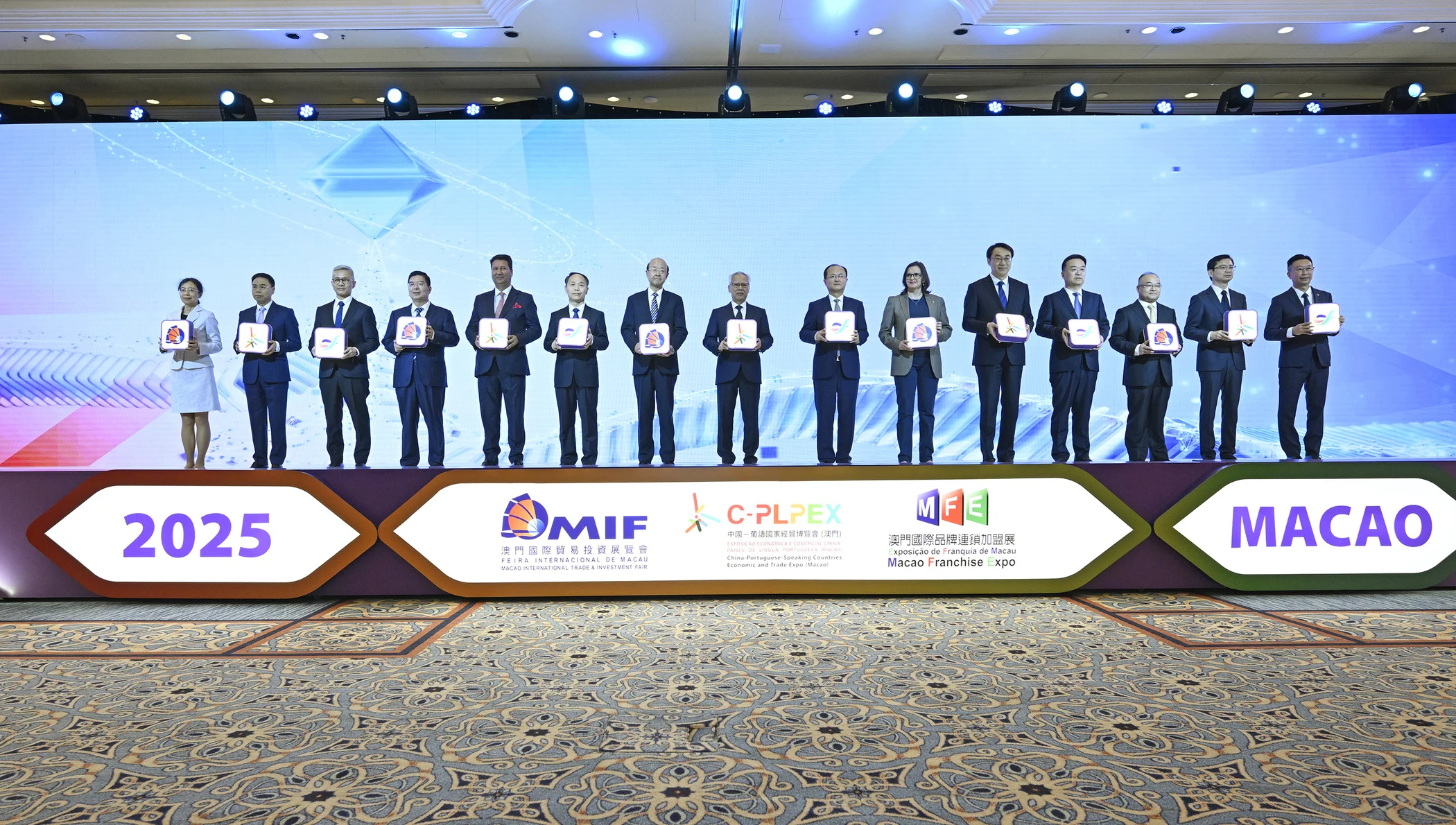
The official was speaking at the China–Portuguese-speaking Countries SME Roundtable, held as part of the 2nd China–Portuguese-speaking Countries Economic and Trade Expo (C-PLPEX) and the 30th Macao International Trade and Investment Fair (MIF). The events are taking place simultaneously and include, for the first time, the China–Portuguese-speaking Countries International Agricultural Expo.
“Macau, as a precise interlocutor between China and Portuguese-speaking countries, can play a key role in connecting markets, enterprises, and resources among the parties involved,” said the Secretary, emphasizing the Government’s commitment to “proactively implementing the Central Government’s guidelines and continuously improving the functions of the Platform for Sino-Lusophone Commercial and Trade Cooperation Services.”
The official recalled that this year marks the 20th anniversary of the comprehensive strategic partnership between China and Portugal, noting that the recent meeting between President Xi Jinping and Portuguese Prime Minister Luís Montenegro reinforced the mutual desire to deepen cooperation in areas such as innovation, the green economy, the blue economy, and the pharmaceutical industry.
“The holding of this Roundtable is a concrete action within the Economic and Trade Cooperation Action Plan (2024–2027) approved at the 6th Ministerial Conference of the Forum Macao,” he stated, adding that the event aims to “help SMEs establish precise partnerships and clarify their market orientation.”
Portugal Highlights Challenges in the Chinese Market
Portugal’s Secretary of State for Agriculture, João Moura, who attended the event in Macau representing the Portuguese Government, stated that Portugal has high-quality products and a “very significant interest” in the Chinese market, despite facing obstacles that hinder access.
“There are many difficulties, often at the level of diplomatic relations, exports, and imports — some adjustments that need to be made,” he explained to journalists.
The official described the events in Macau as “a great window of opportunity” to bring markets closer and “smooth out some rough edges,” emphasizing the importance of direct dialogue between economic stakeholders. João Moura highlighted that Portugal has “several products with great potential” — including nuts, pork, olive oil, and wine — with “strong export capacity and global acceptance.”
“The Chinese market is of great significance to us,” he said, adding that he also felt in Macau “a great interest from China in Portugal,” not only regarding imports but also in the internationalization of Chinese companies in sectors such as technology, machinery, and agricultural equipment.
