


The province of Cuando Cubango, recently divided into two new administrative districts – Cuando and Cubango – remains one of the most heavily mined areas in the country.
Despite progress, the legacy of the prolonged war that pitted the MPLA government forces against the UNITA guerrilla movement remains embedded in the soil after 27 years of conflict, which spread anti-personnel and anti-tank mines throughout the territory.
It is in this area that the heart of the Halo Trust, a humanitarian demining organisation that arrived in Angola in 1994, is currently located.
Its presence in the country was linked to the iconic image of Princess Diana, who was photographed in 1997 walking through a minefield in Huambo, a photograph recreated in 2019 by her son, Prince Harry, on the same historic route.
In Mavinga, the capital of Cuando province and today the largest Halo Trust operations centre in Angola, around 420 people work, out of a total of 1,200 workers mobilised by the organisation. Jack Holmes, commander of Halo Trust’s Mavinga unit, told Lusa that the organisation began operating in the region “in the 2000s” and returned in force in 2021.
“Mavinga is very far away, the paths and roads here are a bit difficult to navigate,” said the Halo Trust representative, alluding to the lack of access to the town, which can only be reached via a sandy track, a journey that can take more than a day from the Cubango capital, Menongue.
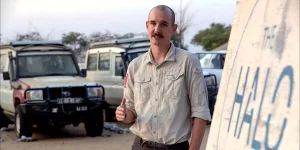
It wasn’t until 2021, with support from the Angolan government, the main funder of demining activities, that it was possible to resume work, Holmes explained. The devices remain a constant threat due to the invisible risk buried in the ground in a region that, decades after the conflict, remains isolated and unpopulated.
The trails that lead to Mavinga cross the typical plains of eastern Angola, which they call “chanas”, and are lined with red and white markings, signposts that warn of dangerous areas. Since 2020, there have been more than 50 mine incidents in Cuando and Cubango, causing at least 37 deaths.
According to the National Mine Action Agency (ANAM), by July 2023, only 42% of the contaminated areas in Cuando Cubango had been cleared, making the eastern province the most affected in the country. Currently, there are 975 identified mined areas, mainly in Bié, Cuando Cubango, Cuanza Sul and Moxico.
“We’re still finding minefields here in Mavinga, also in Rivungo, in Luengue,” confirmed Holmes, guaranteeing that Halo will continue working to clear the mines.
“We have a lot of minefields, we’re going to stay here for as long as it takes to be able to clear all the mines, to return the land free and safe for everyone who lives here, even more important as the new capital of Cuando province,” he added.
Jack Holmes explained that “there are more than 70 different types of mines”, including anti-personnel and anti-tank devices, with the potential to destroy not only local communities, but also the region’s abundant fauna.
“Effectively, we have a very large mix, [but] research work is still needed to find new areas that we know are suspect to confirm exactly where the threat is and what type there is,” he added, emphasising the uncertainty that accompanies the daily work of the demining teams.
Since 1975, more than 80,000 Angolans have reportedly been maimed by mines. Still, the real number of active devices remains uncertain in one of the most contaminated countries in the world, with 73 million square metres contaminated and around 1,000 known or suspected minefields.
Halo Trust has prioritised the clean-up of national parks such as Mavinga, Luiana and Licua, which are also considered strategic for the future of ecotourism.
“Since the clean-up began here, we’ve cleared and destroyed more than 120,000 mines in all. More than 1,000 minefields have been completely cleared. We’ve destroyed 600,000 explosive devices,” said Jack Holmes, emphasising that, “given the size of the country, there’s still a lot of work to be done.”
As well as the humanitarian issue, the economic and environmental future of Cuando and Cubango is at stake.
For the organisation’s representative, demining is also a catalyst for development. Without completing this process, peasants won’t return to their fields, wild animals won’t come back, and tourism won’t develop. “That’s why we want to stay here, to save lives and protect livelihoods,” he said.
In the region, which is home to emblematic species such as elephants and giant black palanquins, cleaning up the parks is seen as essential if the area is to become a centre for ecotourism.
“We are working in Mavinga National Park and in Luengue-Luiana National Park and Licua, where you can find elephants and black palanquins, all these types of animals, to facilitate the return of tourism,” he said.
Under the Ottawa Convention on the Prohibition of Anti-Personnel Mines, Angola has committed to eliminating all devices by 2025. The initial deadline was 2018, but this year Angola requested, for the third time, a five-year extension to the deadline.
With minefields still being cleared, others yet to be discovered, and logistical difficulties associated with access, the goal remains distant.
Platform with Lusa
