

At the two-day meeting in New Delhi, India, strong disagreements over the war in Ukraine, the phasing out of fossil fuels and debt restructuring are expected to dominate the discussions and probably prevent any agreement from being reached by the group, which brings together the world’s 19 largest economies and the European Union (EU).
Joe Biden will talk about “a series of joint initiatives to tackle global problems”, namely climate change and “mitigating the economic and social consequences of Russia’s war in Ukraine”, said White House National Security Adviser Jake Sullivan.
Chinese President Xi Jinping will not attend the summit, which is taking place at a time when trade and geopolitical tensions with the United States and India, with which China shares a long disputed border, are exacerbating.
Beijing is also irritated by the fact that India is a member of the Quad (Quadrilateral Security Dialogue), a security partnership with Australia, Japan and the United States that China sees as an initiative to counter its influence.
The Chinese authorities have not explained why Xi will not be attending the summit on 9 and 10 September, but have merely confirmed that Premier Li Qiang will be joining the leaders of the G20, whose countries account for around 85% of the world’s economy and greenhouse gas emissions.
The absence of the Chinese President could affect Washington’s efforts to ensure that the G20 remains the main forum for global economic co-operation.
“Without China’s participation, there is a risk that issues will not see the light of day or that no logical conclusion will be reached,” said Indian political science professor Happymon Jacob of Jawaharlal Nehru University.
Another shadow hanging over the summit is the war in Ukraine, and Russian President Vladimir Putin will also be absent, replaced by his foreign minister, Serguei Lavrov.
Since March, Putin has been the target of an arrest warrant from the International Criminal Court (ICC), which accuses him of war crimes for the illegal deportation of Ukrainian children. The Kremlin (Russian presidency) has labelled these accusations “null and void”.
“As long as Russia doesn’t put an end to this war, business as usual will not be possible,” said German government spokesman Wolfgang Buechner.
The global crises facing the G20 are “much more difficult, more complicated and more worrying than they have been for a long time”, emphasised Indian Foreign Minister S. Jaishankar.
India, which has just consolidated its status as a space power by placing a spacecraft on the moon in August, sees its presidency of the G20 as a turning point that will definitely make it a major global player.
Prime Minister Narendra Modi presents India as the self-proclaimed leader of the “global South”, which wants to be a bridge between developed and developing countries and is pushing for the bloc to be extended to include the African Union, becoming the “G21”.
Modi is trying to use the G20 to reform multilateral institutions such as the UN and give more weight to developing countries.
“India’s emergence as the world’s fastest growing economy and its inclusive approach are good news for the countries of the South,” argued former Indian diplomat Sujan Chinoy, director of the Manohar Parrikar Institute of Defence Studies and Analyses.
But the Indian leader’s efforts to put pressure on his G20 counterparts to overcome their differences and solve the most important global problems were in vain at the ministerial meetings that preceded the summit.
In July, the G20 energy ministers failed to agree on a timetable for reducing the use of fossil fuels. And they didn’t even talk about coal, a dirty fuel that remains an essential source of energy for India and China.
These two countries are among the biggest polluters on the planet, but they claim that Western countries, which began polluting during the Industrial Revolution two centuries ago, must take on a much greater historical responsibility for the current climate crisis.
Any hope of consensus at the G20 on energy and climate also faces resistance from countries like Saudi Arabia and Russia, who fear that a transition away from fossil fuels will weaken their economies.
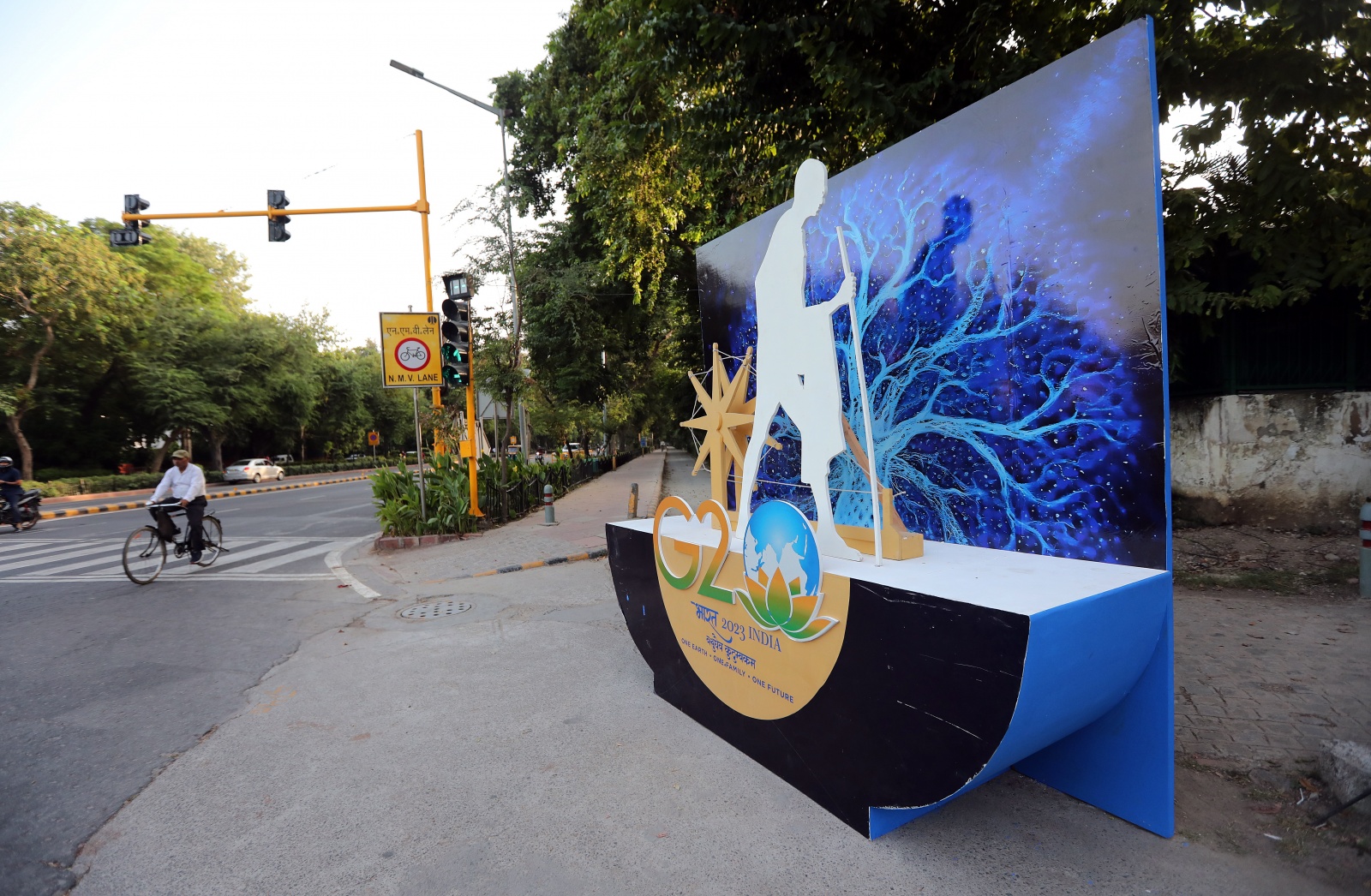
Tens of thousands of security agents, including elite snipers positioned on the rooftops of New Delhi, special forces, anti-drone technology, armoured limousines and “monkey men” recruited to keep away the monkeys proliferating in the Indian capital are some of the security measures adopted by the authorities to host the G20 summit.
A large part of the city centre has been closed to traffic and shops have been forced to shut down. A public holiday has also been declared, which has plunged the usually overcrowded and noisy ultra-populated megalopolis of around 30 million inhabitants into silence.
Illegal slums were destroyed, homeless people living under bridges and along the streets were transferred to “hostels”, fountains were switched on and traffic signs that had been faded for years were given a new coat of paint.
Around 70,000 flower pots were also distributed throughout the city. According to the Times of India, 35 tanker lorries were used to water them.
Several statues to the Hindu god Shiva have also been erected, including one 8.5 metres high, placed at the entrance to the summit venue: the Bharat Mandapam, a recently renovated conference centre near the Raj Ghat memorial to Mahatma Gandhi, where the G20 leaders are expected to plant trees.
