

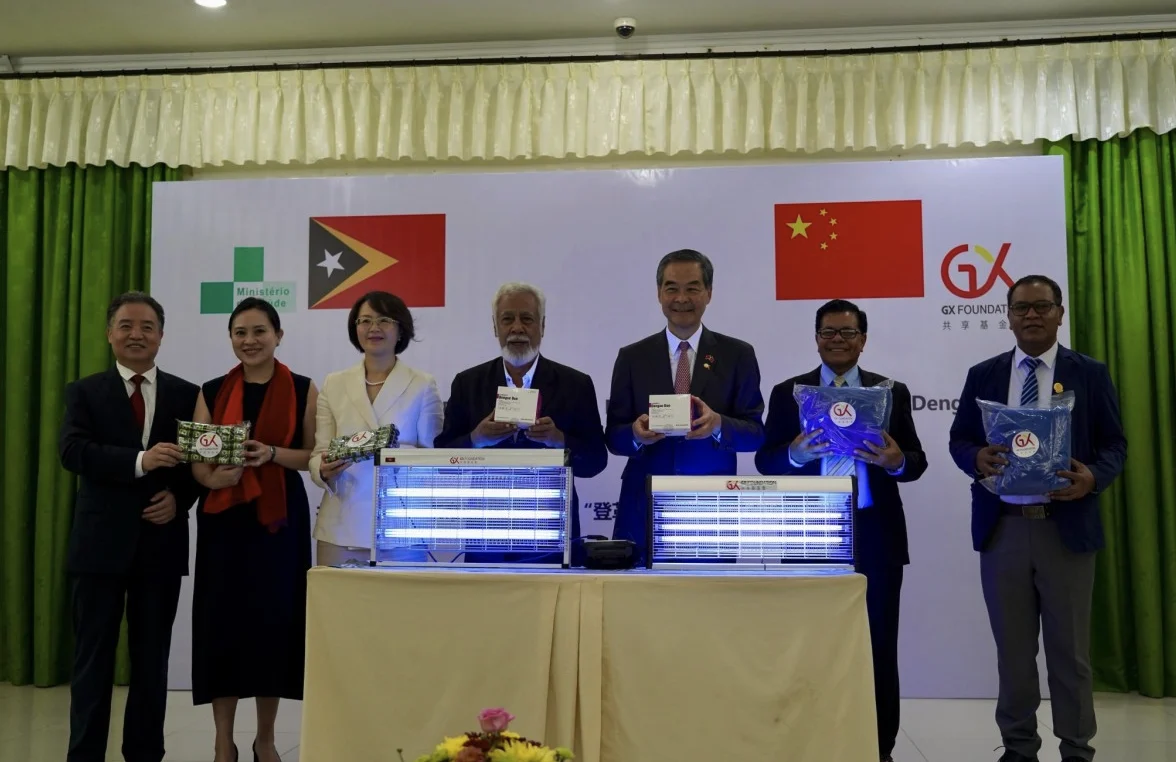
In an interview with Hong Kong’s public broadcaster RTHK, the former leader of the territory’s government said the foundation had expanded its work to ten countries across four continents, offering eight different types of assistance.
Leung added that GX had signed agreements with three local higher education institutions: the University of Hong Kong, the Chinese University of Hong Kong and the Hong Kong Polytechnic University.
The aim, the former Chief Executive explained, is to help students take part in humanitarian work, enabling them to learn “benevolence” in Hong Kong and “compassion” overseas. Leung argued that, amid major changes in the international landscape, China needs not only to consolidate existing friendships with other countries but also to forge new ones.
Hong Kong has many diplomatic opportunities yet to be explored, particularly in the fields of culture, the arts, sport and education, added the vice-chairman of the National Committee of the Chinese People’s Political Consultative Conference.
In October 2024, GX’s chief executive, Emily Chan Ying-yang, told Lusa that the foundation wanted to replicate in other countries—starting with Honduras—a project that had reversed the rapid growth of dengue in East Timor.
Between January and July, GX installed more than 1,670 anti-mosquito lamps and distributed nearly 30,000 adhesive insect traps, close to 18,000 rapid dengue detection tests and around 500 mosquito nets across East Timor’s 14 municipalities.
Emily Chan said she was “very proud” of the project’s success in East Timor, the first of its kind for the foundation, which was established in 2018 and until 2024 had focused mainly on cataract surgeries.
She stressed that, according to official data from Timor-Leste’s Ministry of Health—one of GX’s partners—the number of dengue cases fell by 10 per cent in the first half of 2024 compared with the same period a year earlier.
By contrast, the prevalence of the mosquito-borne disease more than doubled across south-east Asia, she noted. In the first half of 2024, the number of cases in Dili, the capital of East Timor, fell by 46 per cent.
The success of the project led the Government of East Timor to decide to extend the programme until 2026, a two-year period during which GX plans to install 2,600 anti-mosquito lamps and distribute 85,000 rapid tests, 80,000 adhesive traps and 800 mosquito nets.
