

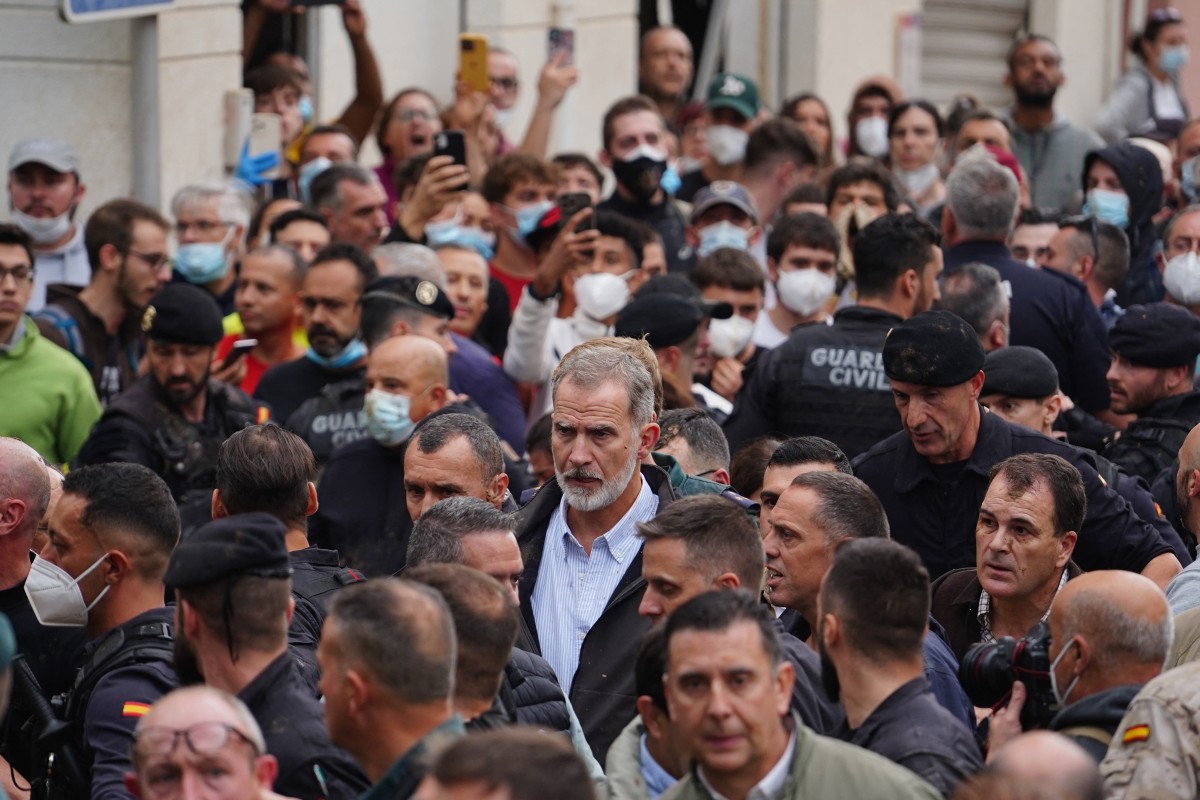
On October 29, 2024, a “cold drop” or DANA, as it is known in Spain, formed in southern Iberia, causing intense and concentrated rainfall, particularly in the interior of the Valencia region, where rainfall levels recorded in 24 hours were among the highest in Europe.
The heavy rainfall flowed towards the Mediterranean coast through ravines and slopes, inundating roads and streets in various suburbs of Valencia, one of Spain’s most densely populated areas.
According to official data, 229 people died in the autonomous region of Valencia, seven in a neighboring area of Castilla-La Mancha, and one in Andalusia (southern Spain). In Valencia, the epicenter of the tragedy, the storm affected an area of about 553 square kilometers across 75 municipalities, impacting 306,000 people.
The regional government reported damages of at least €17.8 billion to housing, supply and transport infrastructure, natural parks, schools, health centers, cultural and social facilities, and 64,100 businesses, among other sectors.
Spain’s national meteorological agency (Aemet) had issued a red warning for rain starting at 7:00 AM for the Valencia region, but it wasn’t until 8:11 PM that residents received a civil protection alert on their phones, managed by regional governments.
This alert was not only delayed but also contained information deemed inadequate for the flood risk situation, catching coastal populations by surprise where no rain had occurred during the day.
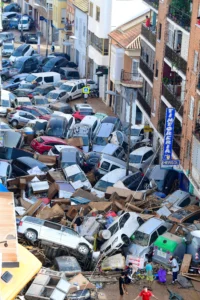
Persons climb on piled up cars following deadly floods in Sedavi, south of Valencia, eastern Spain, on October 30, 2024. – Floods triggered by torrential rains in Spain’s eastern Valencia region has left at least 70 people dead, rescue services said on October 30. (Photo by Jose Jordan / AFP)
According to the initial report from the judicial investigation into potential criminal responsibilities for the deaths of 229 people in Valencia, most victims died before the civil protection alert reached their phones.
The floods are also being examined by three parliamentary committees (in the Valencian regional parliament, the Spanish parliament, and the Spanish Senate) formed to investigate political responsibilities.
None of the committees have reached conclusions yet, and the Spanish parliament’s committee is expected to have the most significant impact, starting hearings in mid-November, including testimonies from the head of the Valencian regional government, Carlos Mazón of the People’s Party (PP, right), and Spanish Prime Minister Pedro Sánchez.
Since the floods, due to the late alert and public information considered partial and contradictory, Mazón has become the main target of public criticism, leading to 12 protests in Valencia over the past year calling for his resignation, mobilizing tens of thousands of people.
In recent weeks, victims’ families have asked Carlos Mazón not to attend the state funeral scheduled for today at 6:00 PM local time (5:00 PM in Lisbon) at the Valencia Science Museum.
The “state funeral to honor the victims of DANA” will be attended by Spain’s highest authorities, including King Felipe VI and Queen Letizia, along with Prime Minister Pedro Sánchez and family members of the deceased. Remarks are expected during the ceremony from Felipe VI and representatives of the victims’ families.
Platform with Lusa
