

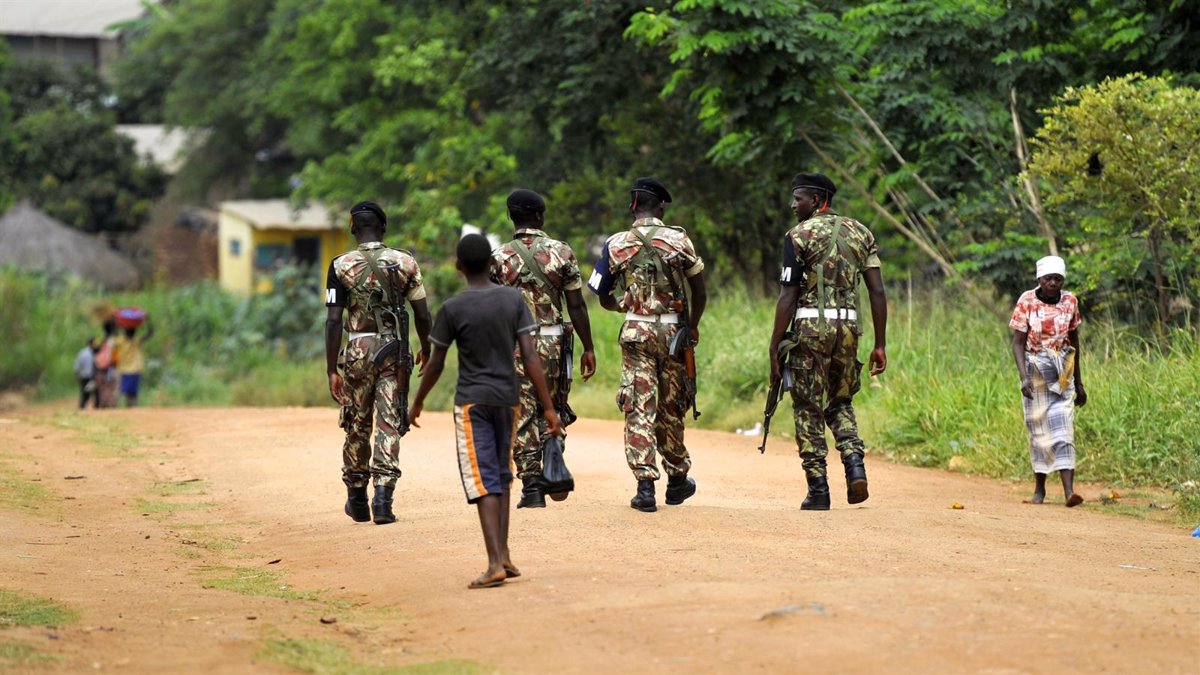
The claim, made through Islamic State (IS) propaganda channels, said the attack took place near Nangade, during which “they captured one of the Christians” and “executed him”.
Other claims in recent days, confirmed by local Catholic Church sources, point to houses and churches being set on fire in various parts of Cabo Delgado since the end of July, including the beheading of several ‘Christians’ among the general public.
On Saturday, the same group claimed responsibility for another attack on a village in the Ancuabe region the previous day, with the rebels claiming that they had “captured a member of the local militia”, who was then “beheaded”.
The day before, but in the Balama region, insurgents allegedly belonging to the Ahlu-Sunnah wal Jama`a (ASWJ) group, associated with Islamic State, claimed to have set fire to the home of a local “militia commander” in an apparent reference to the ‘naparamas’ guerrillas, who are also fighting these groups.
At the end of last week, the same group had already claimed responsibility for another attack in Chiúre, south of Cabo Delgado, and the death of 18 “naparamas” paramilitaries, using different weapons. In that previous message, the extremist group claimed responsibility for the death of 18 members of these traditional local militias in the attack in Chiúre and the destruction of “dozens of houses” and motorcycles.
The “naparamas” are Mozambican paramilitaries who emerged in the 1980s during the civil war, combining traditional knowledge and mystical elements in the fight against enemies, operating within the community. In Cabo Delgado, these militias support the Defence and Security Forces (FDS) in the fight against extremists who have been operating locally since 2017 and have already displaced more than one million people across the province.
More than 57,000 people have been displaced since 20 July in the Mozambican province of Cabo Delgado following a resurgence of attacks by extremists, according to data from the International Organisation for Migration (IOM).
According to the latest IOM report, with data from 20 July to 3 August, “the escalation of attacks and growing fear of violence” by non-state armed groups in the regions of Muidumbe, Ancuabe and Chiúre have led to the displacement of approximately 57,034 people, comprising a total of 13,343 families.
This includes 490 pregnant women, 1,077 elderly people, 191 people with mobility problems and 126 children separated from their parents, who walk more than 50 kilometres through the forest, night and day, mainly towards the district headquarters of Chiúre, in the south of Cabo Delgado province.
This is the highest peak of people displaced by attacks and heading for Chiure headquarters in about a year. The IOM information adds that agents on the ground indicate that “food is the most urgent humanitarian need”, followed by shelter and non-food items.
Of this total number of displaced persons, 22,939 were sheltered in Namisir and 27,558 in Micone, in both cases in two schools in the village of Chiúre, the district headquarters. The Minister of National Defence admitted at the end of July that he was concerned about the wave of new attacks in Cabo Delgado, adding that the defence forces were on the ground pursuing the armed rebels.
“As a security force, we are not satisfied with the current situation, given that in recent days the terrorists have had access to areas further away from the centre of gravity that we had identified,” Minister Cristóvão Chume told journalists.
Platform with Lusa
