


“The RRP is €22 billion for five years. Tourism is generating one and a half RRP per year for our economy,” said Pedro Machado, referring to the Recovery and Resilience Plan (RRP) financed by European funds.
In a speech focused on the economic and strategic strength of the sector, the secretary of state highlighted that, in 2024, Portugal recovered the tourism levels of 2019 – the best year before the pandemic – and has already surpassed them.
For this year, the Government estimates growth of 3 to 4% in the number of tourists and 6% in revenue, which could raise the annual total to around €30 billion.
Pedro Machado rejected the idea that the country is overly dependent on tourism: “It is not true that Portugal is dependent on a single industry. Tourism cuts across 49 economic activities,‘ he said, pointing to the impact on mobility, agriculture, culture and manufacturing.
Another idea he dismissed was that the country has ’too many tourists‘. “No, we don’t have too many tourists. What we need to do is distribute the flows better, in terms of time and across the country,” he said.
The minister also said that the new National Tourism Strategy 2030 should be presented in September, which will be based on a “triangle” of priorities: sustainable growth, improving the tourist experience and visitor satisfaction.
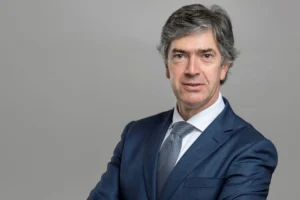
Pedro Machado rejected the idea that the country is overly dependent on tourism: “It is not true that Portugal is dependent on a single industry. Tourism cuts across 49 economic activities’.
On mobility, he stressed that 96% of arrivals in Portugal are by air, which reinforces the importance of resolving constraints at airports and expanding routes. “TAP is opening new connections with the United States, Mexico, Argentina, Australia and Saudi Arabia,” he recalled.
Pedro Machado also addressed the problem of labour shortages in the sector, advocating measures such as the creation of a “green channel” for immigrant workers. “We already had this problem in 2019. Today, 15% of the population residing in Portugal is foreign and makes a fundamental contribution to our economy,” he said.
The secretary of state also highlighted urban regeneration projects supported by the Portuguese tourist board, Turismo de Portugal: “We have already restored several municipal markets and visitor attractions. These are public policy instruments on the ground.”
In the same speech, Pedro Machado, argued that immigration is essential to fill the labour shortage in the tourism sector and ensure its sustainable growth.
The growth of tourism depends largely on whether we can continue to count on human resources. In this sense, immigration has a very important role to play,” he said.
The minister warned that “there is no installed capacity in terms of human resources” to cope with the growth of the sector, which is expected to account for around 16% of Gross Domestic Product (GDP) this year.
According to Pedro Machado, tourism has been “one of the most robust engines” of national economic growth and is expected to generate more than €25 billion in revenue this year, equivalent to ‘almost one and a half Recovery and Resilience Plans (PRR)’.
If we are not able to train, retain, motivate and integrate these human resources – both Portuguese and foreign – we will not be able to continue to grow our economy based on tourism,” he stressed.
To respond to this challenge, the Government is “doing its homework” and creating a “green channel for immigration” to facilitate the entry and integration of foreign workers. “We have to treat both our existing workforce and those we are receiving well,” he stressed.
Pedro Machado also pointed out that ‘15% of the population living in Portugal is immigrant’, according to the latest estimates, but recalled that the country also has a strong tradition of emigration. “Portugal is, first and foremost, a country of emigrants. And that is why we must have a responsible, humane and respectful attitude towards those who arrive here,” he said.
The secretary of state also warned that without a structured response to the labour shortage and the need for skills, the sector’s growth could be compromised. “We cannot miss this opportunity,” he said, referring to tourism’s contribution to the country’s economic development.
Platform with Lusa
