

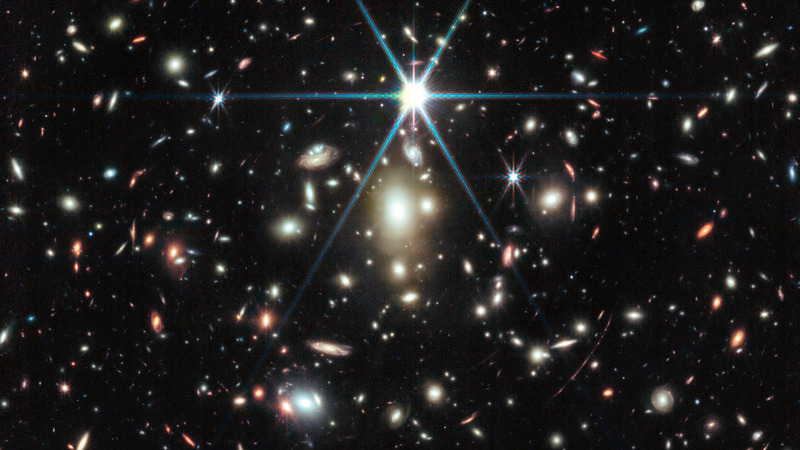
The star is so far away that its light took 12.9 billion years to reach Earth. Therefore, it can only be observed through an effect called “gravitational lensing”, formed by the galaxy cluster WHL0137-08.
In images from the James Webb Telescope, Earendel appears as “a single point of light”. In this way, scientists estimate that the star’s light has been magnified at least four thousand times and that it is “extremely small”.
Stars as massive as this one usually have neighboring stars. However, according to NASA, experts did not expect to find any other objects in the vicinity of Earendel, as “it would not be possible to distinguish them”.
Still, the star’s colors seem to reveal that Earendel is accompanied by a “colder, redder star”.
Read more at TSF
