

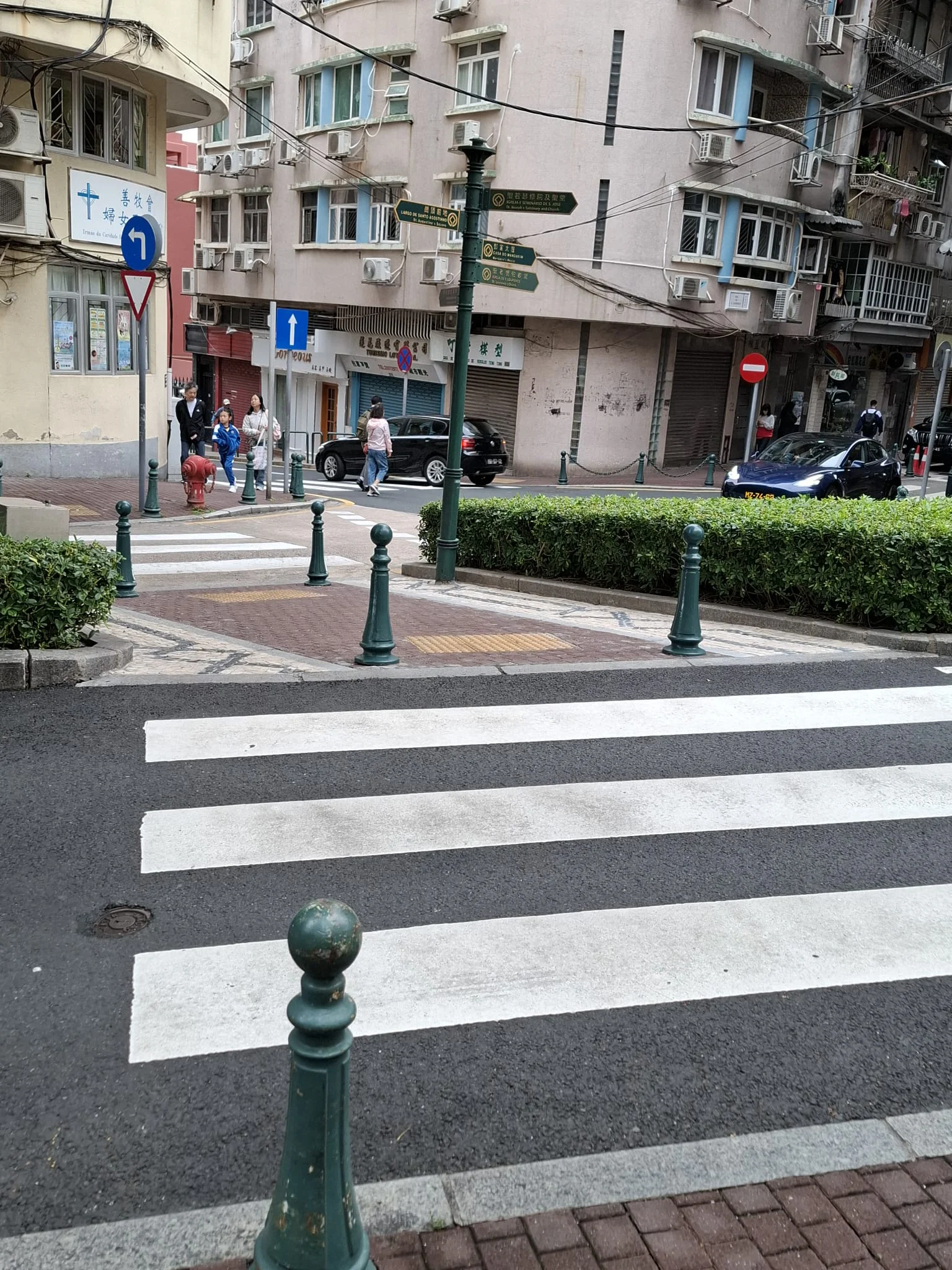
Macau has seen a series of traffic accidents involving pedestrians on crosswalks. Late last month, a man was hit by a private car while crossing near Sai Van Lake. In May, a young girl was struck by a truck while crossing with her family at the intersection of Praça de Monsaratt and Travessa de Monsaratt. In July, a seven-seater vehicle injured a pedestrian on a Green Island crosswalk after failing to yield.
“The problem lies in structural issues within road management,” says Kaleb Lam, noting that “at present, the roads are managed by multiple departments, and there is no unified, transparent directive, which raises questions about communication between entities.” Regarding crosswalk layouts, he suggests following accessible design standards and creating clear guidelines that define which crossings should be modified, allowing the public to provide input based on specific criteria.
To improve pedestrian safety, mechanical and electronic engineer Addy Chan proposes adopting practices from Portugal and Spain: “Traditionally, sidewalks are higher than the road surface, but the new concept raises crosswalks to the same level as sidewalks, forcing vehicles to go up a ramp, which reduces speed and gives pedestrians priority. This design greatly decreases the likelihood of vehicles injuring pedestrians on corners, improves the walking experience, and is particularly beneficial for wheelchair users,” he tells PLATAFORMA.
The Transport Bureau (DSAT) explains that “the principle is similar to the speed bumps already used in Macau” and that it “will draw on international experience and carefully assess applicability based on traffic volume and vehicle speed in different parts of the city.” According to DSAT statistics, between the second quarter of 2020 and the same period in 2025, the number of crosswalks on the Macau Peninsula increased from 1,328 to 1,470, while in Cotai the number rose from 708 to 929.
Reduced Accessibility
However, local resident Choi, who lives in the San Kio district, says that “although the data show more crosswalks, I don’t feel any safer crossing the streets in Macau. When I take elderly relatives in wheelchairs, the crosswalks in our neighborhood always force us to make detours, preventing direct and smooth passage. It’s very time-consuming and inconvenient.” As a mother of two, she adds, “I’ve had situations where cars braked abruptly at crosswalks. Every time I see news about accidents, I feel anxious and increasingly afraid to let my children walk home from school.”
Local designer Ao, who has long studied Macau’s crosswalk design, believes that “government policy clearly favors building pedestrian overpasses to achieve a ‘separation between pedestrians and vehicles,’ based on the belief that crosswalks disrupt traffic flow.” In theory, crosswalks are the most convenient way for pedestrians to cross, and unless overpasses can form continuous networks—like in some areas of Hong Kong—the “physical effort and time required to use them are disproportionate.”
This leads many pedestrians to cross outside designated areas, creating a vicious cycle: “The more overpasses there are, the less drivers develop the habit of yielding, which increases danger for those who cross at street level,” he tells PLATAFORMA. Ao cites concrete examples, such as “the unannounced removal of a crosswalk on Avenida do Ouvidor Arriaga near Rua de Francisco António two years ago,” explaining that “those going from Avenida de Horta e Costa to Kiang Wu Hospital now have to cross the street several times, which is extremely inconvenient for pedestrians, parents with strollers, and wheelchair users.”
He also points to the intersection of Avenida do Ouvidor Arriaga and Rua do Padre João, where “authorities moved the crosswalk about ten meters away from the intersection, claiming it would facilitate vehicle exits. This change forces pedestrians to take a U-shaped route with a 90-degree turn to the Rua do Padre João sidewalk. The sidewalk width abruptly shrank from 1.7 meters to just 90 centimeters—below the 1.2-meter minimum required by the Universal Accessibility Design Guidelines. This kind of design prioritizes vehicles and pushes pedestrians and wheelchair users into a narrow, unsafe zone.” He criticizes such changes as “arbitrary and unjustified.”
“Luck Mentality”
Regarding crosswalk placement, DSAT states that “especially in older neighborhoods with limited space, a balance must be found between convenience, accessibility, safety, and traffic efficiency.” For narrow sidewalks, the department “will work with other entities to assess the feasibility of widening them, seeking to optimize the pedestrian environment.” It also says that during the planning process, it issues technical opinions on new projects and collects public input through channels such as the Transport Advisory Committee and community associations.
Designer Ao also highlights “the low fines currently in effect.” Under Article 104 of the Road Traffic Law, drivers who fail to yield to pedestrians on marked crosswalks face fines ranging from MOP 600 to 2,500.
According to Addy Chan, “penalties are an essential tool. In the past, violations such as not stopping or slowing down at crosswalks were often resolved only with verbal warnings, without real punishment. A clear mechanism is needed.” He adds, “Mainland China has made progress in recent years with automatic electronic enforcement, where fines are issued based on camera footage. Only this way can we eliminate the so-called ‘luck mentality.’ The main problem isn’t a lack of safety awareness—it’s the belief that nothing bad will happen.”
