

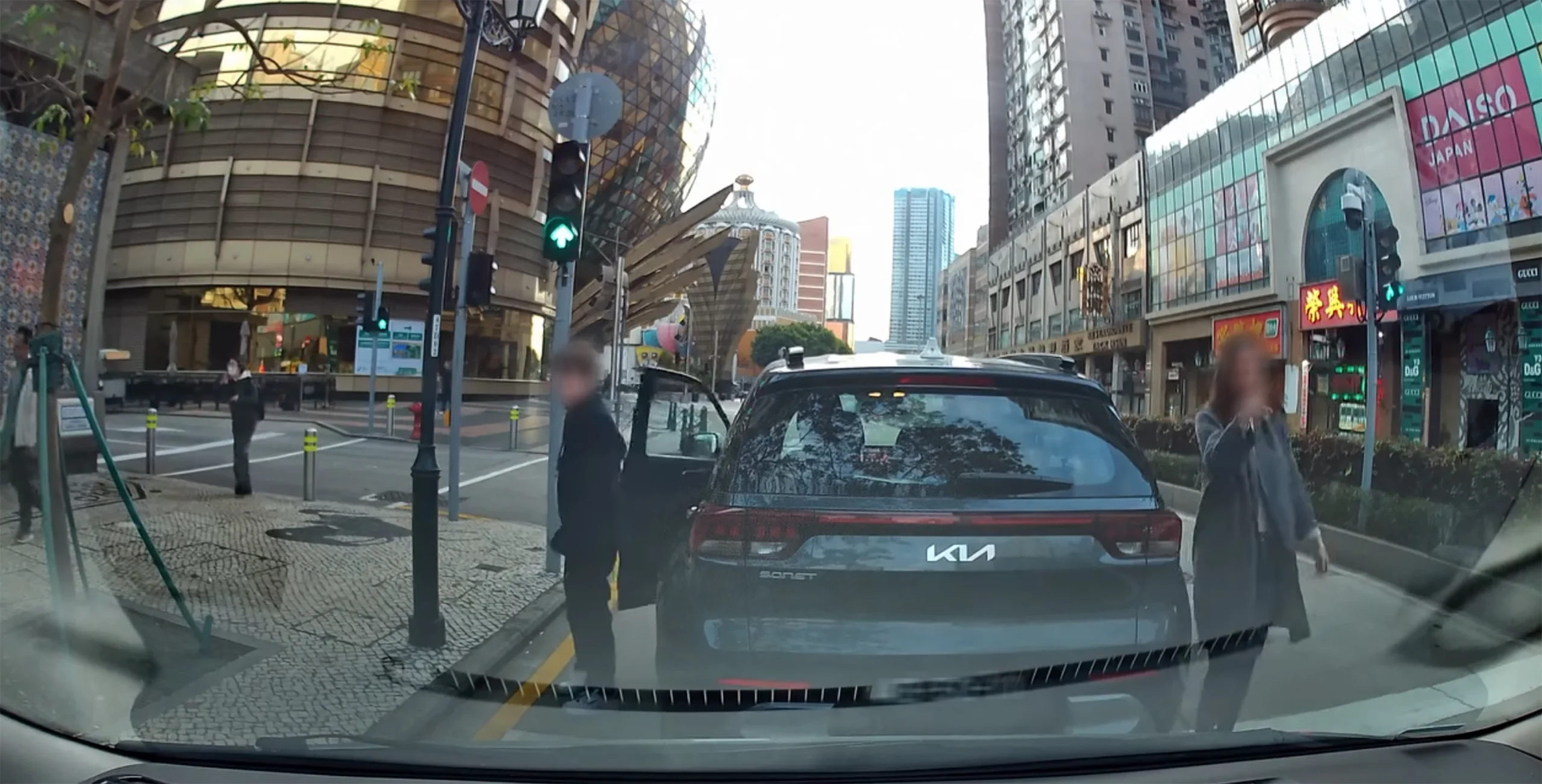
The video, shared last month on a Macau-based Facebook page, triggered a wave of xenophobic and discriminatory comments against the person involved. Filmed through a dashboard camera, the published version—without sound—shows a Portuguese national arguing with an unidentified driver following an illegal maneuver in front of the Portuguese School. The individual in question makes an obscene gesture while arguing with the driver who recorded the incident. Both committed traffic violations, but there is another key issue: recording and sharing footage without consent constitutes the crimes of invasion of privacy and unlawful recordings.
The video—still available on the same Facebook page—also exposes the two minor children of the person involved and sparked a flood of over 300 comments. Some of these comments were insulting and even xenophobic and discriminatory. The identity and profession of the person involved, who is a lawyer, were quickly revealed and shared on social media, with personal details and workplace information posted across various online platforms in Macau and Hong Kong. Contacted by PLATAFORMA, a lawyer refused to comment on the case. Of Chinese origin, she admitted feeling uncomfortable with how the social media debate had taken on “racial undertones.”
The case gained such momentum that the Public Security Police (CPSP) issued a statement a few days later, announcing that they had investigated the behavior of both drivers. Their conclusion: “One of the drivers committed multiple violations of traffic law, while the person who filmed the video also committed a traffic offense.” PLATAFORMA questioned the CPSP for details on the infractions, but the department only confirmed in a response in Chinese that a “process” had been initiated against the driver(s), without specifying whether it was against only one or both involved. However, in the same response, the CPSP acknowledged that while “recordings from dashboard cameras or footage filmed on the street” are “legal” and can even be “used as evidence,” those who share them “may also be committing an illegal act.”
“Invasion of Privacy”
“The controversy surrounding this case has largely focused on the obscene gesture made by this Macau resident, and very little on the crime committed by the person who shared this video on social media. We only have footage of this argument, without knowing the full context or seeing one of the parties involved,” lawyer Pedro Leal told PLATAFORMA. “There has been little discussion about the fact that sharing this content may constitute two crimes: invasion of privacy and illegal recordings or photographs,” he concluded.
According to Article 186 of the Penal Code, capturing, photographing, filming, recording, or disseminating someone’s image “without their consent and with the intention of invading their privacy” constitutes a crime punishable by up to two years in prison or a fine of up to 240 days. Under Article 19, the same penalty applies to anyone who, without the consent of the other party, “records words not intended for the public, even if directed at them” or “uses or allows the use of such recordings.” Since these are semi-public crimes, “the person involved would need to file a complaint with the authorities for legal proceedings to begin,” Pedro Leal explains. According to what PLATAFORMA has been able to determine, the individual in the video has not yet made a decision on whether to file a complaint.
It is common practice in Macau to share footage from dashboard cameras—known as ‘dashcams’—on social media. These often capture accidents or incidents on public roads, frequently without safeguarding the identities of those involved or other identifying elements such as license plates. According to the Personal Data Protection Law, information such as license plates or facial images that allow individuals to be identified is considered personal data, and its unauthorized publication may result in legal liability. Social media platforms themselves also enforce regulations regarding the sharing of content without the consent of those involved, often requiring users to submit a request for evaluation before determining whether the content violates platform policies.
In comments to Macao Daily News, Ho Ka Hou, vice president of the Supervisory Board of the Macau Legal Studies Association, emphasized the need to protect the privacy and personal data of third parties, calling for stricter safeguards to ensure that the collection and use of recordings are only for “legitimate purposes.” According to the legal expert, the use of such recordings for criminal investigations “does not require the consent of the individuals filmed.” Judicial practice considers that driving is not part of a driver’s private life, which legitimizes the use of images as evidence. However, Ho notes that the principle of “legitimate purposes” requires that dashcams be used to record accidents or ensure road safety in collaboration with authorities. He concludes that sharing videos online without consent—especially when used to criticize or expose individuals to “moral judgment,” as in this case—“violates this principle.”
