

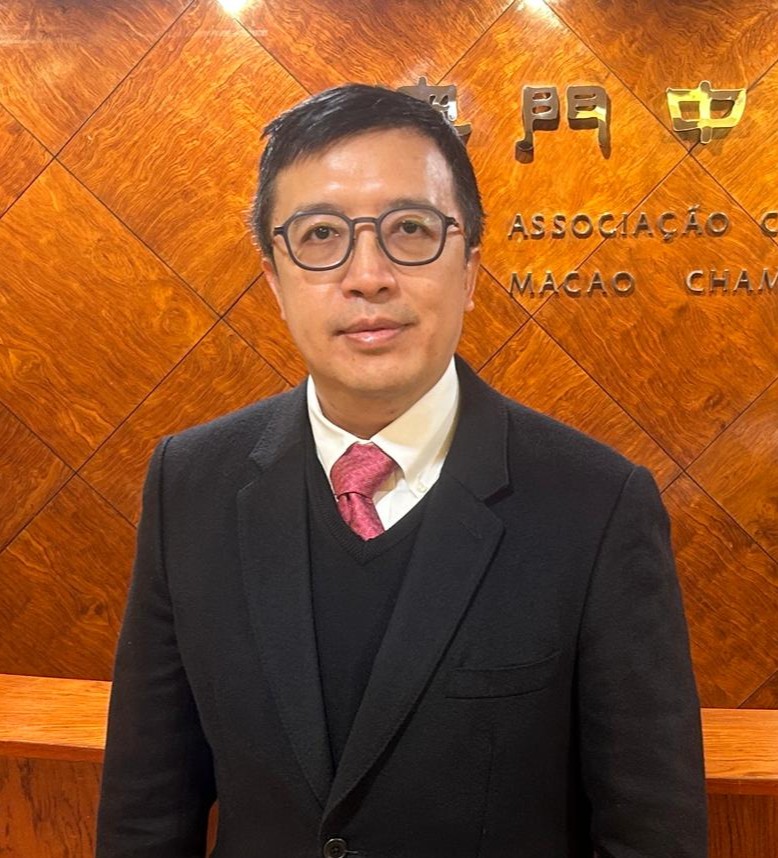
What are the main objectives of the Chamber of Commerce in the near future?
F.M. – We have SME members linked to commerce, but also other industries and various associations; we are like a large umbrella as the Chinese chamber of commerce. Our purpose is to promote business, build bridges, attract investment to Macau; but also to help our members expand abroad; bring investment, and become global. We are in a transition process, with the market constantly changing; and even in China, consumer behavior is changing. In the past, tourists came and spent a lot of money, today most tourists want different experiences. We have to transition from the traditional way of doing business to the new productive forces; and adapt to the habits of the so-called Generation Z.
Focus on digital transition?
F.M. – Digital is especially important for promotion, using platforms from mainland China. But modernization has many other aspects; the approach is more diversified.
What is your agenda in the Executive Council?
F.M. – I represent the Chamber of Commerce; and I try to get the Government to increase economic stimulus. We have done this in the past – we will do it in the future. Mainly during the pandemic, we worked with the Government on stimulus measures like the consumption card, and business support. We continue this work; and we have been talking a lot about the current situation of SMEs.
More support for consumption, or for business?
F.M. – When we support consumption, the goal is to promote business; if customers don’t spend, SMEs don’t have revenues, and they can’t cover their expenses. That’s the logic behind stimulating consumption. Moreover, it’s necessary to support companies in transitioning to the new productive forces.
Based on new technologies?
F.M. – New technologies and new ways of doing business. New productive forces is a term we borrowed from the Central Government.
The budget for this year has already been approved by the Legislative Assembly, proposed by the previous Executive. Does this limit the options of the new Government?
F.M. – There will be some room for new policies. Since we are in a transition year, the new Chief Executive will present the Government Action Lines in March or April; but he can request amendments to the budget law from the Legislative Assembly. We did this many times during the pandemic, and we have a special procedure for that. As for wealth redistribution policies – like the ten thousand pataca cash voucher – everyone continues to receive, and most of these policies will continue. But there is room for new policies.
A large-scale economic stimulus package?
F.M. – A large-scale one might be difficult. Although we have a budget surplus, the margin is tight; and we still have some challenges to meet the revenue goals from the casinos. If we want a balanced budget without resorting to the Financial Reserve, a large-scale stimulus plan is hard. But I think the new Government will have room for some new measures.
Many associations complain about losing subsidies. Could this change?
F.M. – It’s not entirely true; to be more precise, there are new rules and application assumptions; with more focus on quality – instead of quantity. It’s true that this benefits some large associations, which have already set up their processes and have staff to work on projects. It may be more difficult for small associations to apply for funding; if they don’t have manpower and know-how, the subsidy might not be approved. Before, anyone could set up an association and ask for funding; now it’s necessary to help the members, and society, in line with the Government’s objectives.
What do you expect from the new Government?
F.M. – During the consultations that the new CE held during the campaign, he suggested that the Government should focus on certain areas, like science and technology. In the past, we had a small Government and a large market; the new CE should take the lead on the 1+4 strategy, where sectors need investment and support plans. I wouldn’t say a big Government, but one more proactive in some of these areas.
Is the private sector ready for the 1+4 industries?
F.M. – For 25 years after the transfer of sovereignty, we had many changes in the private sector, especially with the liberalization of Gaming. International corporations came to Macau; and in the Chamber of Commerce, we helped SMEs integrate into these supply chains. For many years, we’ve met high demand standards and provided for six concessionaires. Local SMEs had to adapt.
Can this experience be repeated in other areas?
F.M. – As we introduce new international companies, we need to improve local supply chains. If there’s investment from abroad, we’ll adapt. We’ve always done this, even before the handover, when in the 1980s/90s we were receiving orders from abroad. As in the past, we’ll have to adapt to the demands and adopt new quality standards.
Are Macau’s entrepreneurs ready to invest in the Greater Bay Area?
F.M. – In 2022, we established the Guangdong office in Hengqin; the first one outside Macau. There, we support SMEs from Macau investing in the Greater Bay Area; we work closely with the Government to introduce new policies; and we’ve held some seminars and workshops so that Macau companies learn more about tax systems and labor laws in mainland China.
The question is whether there is capacity and willingness to invest in this opportunity…
F.M. – Some companies would like to do so, especially because the mainland China market is very vast. I’m not saying all SMEs should look for new markets; but some store chains are already well-established businesses that actively sought opportunities in the Greater Bay Area. Hengqin is a growing market, it has evolved very quickly and attracts more and more companies. I have a hotel there and I know that economic activity is growing, especially since the second border line was created in March 2024. The financial sector is also growing rapidly; and anyone who wants to maintain an office there now must have staff there; so many people are moving to Hengqin. Meanwhile, digital giants like TikTok are also setting up in Hengqin.
Are Portuguese-speaking Countries also an opportunity for Macau businesses?
F.M. – Yes, because China has assigned Macau and Hong Kong the mission of helping to achieve a high level of openness to the outside world, including attracting talent. It is our responsibility to do so. The Lusophone platform has been growing, and in the last 20 years, it has achieved economic results; but also in science, culture, technology, and education. When we talk about the platform, we don’t just focus on the economy, although the results are already 20 times higher than in 2003: 20 billion dollars in business volume places the Lusophone countries, together, in the tenth position in China’s ranking; after Australia and before India. So, it’s very good.
Directly, without passing through Macau…
F.M. – I understand, but we need to focus on what we have, like the Forum Macau. We have done a lot in the field of foreign relations; in technology, culture, and business contacts. Macau is very small, and our business volume is very low. In the future, we must support the services sector, namely legal, consulting, translation, etc. We can invest more in the professionalization of services related to the Lusophone platform. When we internationalize the yuan, we will need settlement services, and Macau can also play an important role there.
