


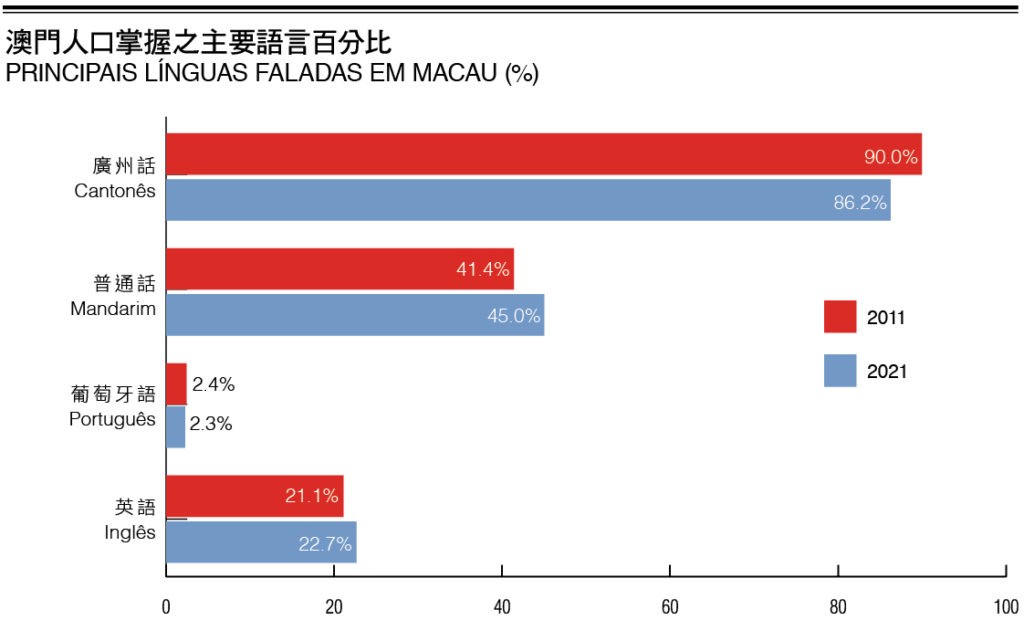
The 2021 Census reveals that more than 80 percent of the population is fluent in Cantonese, 3.8 percent less than in 2011. The number of residents fluent in Portuguese has also dropped to 2.3 percent. Sulu Sou, former member of the Legislative Assembly, and Agnes Lam, director of the Macao Studies Center, spoke with PLATFORMA about the decline of both languages, offering solutions for students to be enthusiastic about them.
Sulu Sou, a former deputy of the Legislative Assembly, wrote an interpellation to the then Directorate of Education and Youth Services where he pointed out that before the transfer of sovereignty “there was an annual increase in the population that used Cantonese as the language used mostly at home”.
However, after the transfer, “the respective number started to go down”. This concern is now confirmed with the publication of the 2021 Census: native Cantonese speakers decreased by 2.3 percentage points compared to 2011, the year in which the last census was carried out in Macau.
“What concrete measures does the government have to prevent the continued worsening of the tendency for more and more students not to master Cantonese?” he asked.
At the time, the response from the Directorate of Education and Youth Services (DSEDJ) reiterated the fact that “the increase in the immigrant population causes a change in the proportion of the current language”. In fact, the number of residents in 2021 decreased to 83.4 percent – a drop of 4.4 – as its size did not keep up with the growth in the number of foreign workers and students, which increased by 51.9 and 279, 7 percent, respectively.
“However, in 2016, the general population using Cantonese increased to 57,351 people, compared to 2011. Of the residents, in general, aged between three and 19 years, who are attending basic education, 87 percent speak Cantonese as their current language. This is more than 80.1% of the average for general residents”, reads the DSEDJ’s response.
Speaking to PLATFORMA, Sulu Sou says that the 2021 Census data do not show significant changes, but there is “a negative trend”, despite a slight increase in language mastery in children between three and 15 years old. – school age.
“The problem is that we do not see any specific measures being implemented by the Executive to promote the teaching of Cantonese”, stresses Sulu Sou, adding that this factor, together with the high number of immigrants living and working in Macau, has led to several schools to choose Mandarin as the main language of instruction.
“These circumstances, together with the various factors at play, created the current situation,” he underlines.
Mandarin is dominated by 45 percent of the population, having grown by 3.6 in the last 11 years. English is also on the rise, spoken by 22.7 percent, with an increase of 1.6 percent compared to 2011.
The former deputy considers the decline of Cantonese to be moderate, but does not want to ignore the possibility that the situation will worsen in the future. Hence, it is essential for the Government to implement concrete actions that “enable students to learn both Cantonese and Mandarin and become proficient in yet another language, this being Portuguese or English”.
“Macau must guarantee Portuguese teaching”
The population fluent in Portuguese recorded a drop of 0.1 percent, and the proportion of residents over 30 years old and with some command of the Portuguese language grew. The population that uses Portuguese on a daily basis fell by 0.59 percent, and the number of people between 30 and 50 years of age with some command of the language also reduced.
Agnes Lam, director of the Macau Studies Center at the University of Macau, opines that the language proficiency of the population over 30 mainly reflects the education after the transfer of sovereignty.
Also read: Macau and the Portuguese language
Currently, with regard to the population aged between three and 29, there has been an increase in language proficiency, something related to the promotion of Macau as a point of contact between China and Portuguese-speaking countries since the transfer. “I think that’s the most obvious and straightforward factor,” she says.
“In fact, the number of applications for the Portuguese Language Department at the University of Macau has grown over the last 11 years, as has the number of students choosing Portuguese as their main area of study. This result proves the effect of the platform’s promotion policy,” she clarifies.
As such, the deputy also believes that with this current policy of focusing on Macau as a link to Lusofonia, the proportion of Portuguese-speaking residents will also continue to grow.
In addition, it states that the young population “is willing to learn and understand the usefulness of Macau in the future”.
“Older people may have had some knowledge in this area, but they may no longer make use of it because they do not apply it in their area of work, but there are many possibilities”, she underlines.
Agnes Lam also believes that it is positive to continue to promote the teaching of the Portuguese language in primary and secondary schools, also revealing that it is a “very strong feature of the city”.
The professor at the University of Macau praises the importance of Portuguese in primary and secondary education, noting that this ensures that Macau “is a diverse city”.
“Universities are depending on the promotion of Macau as a platform, so it is also important that the population is aware of future career opportunities in the area”, she specifies.
On the other hand, the Census also revealed an increase of 1.6 percent in the proportion of residents with proficiency in English over the last 11 years. Academic Keith Morrison published an article in March 2021 in which he points out that the level of English language among Macao students varies widely and is far from ideal. Despite this, the use of English as a current language (3.6 percent) increased by 1.3 percent compared to 2011 data, with some universities using English as the language of instruction.
Agnes Lam admits that the level of proficiency of university students is clearly polarized and believes that, if Macau wants to be an international urban center, the English level of the population will have to improve.
“Until now, Macau has never recognized the importance of proficiency in English, but I believe it is a positive thing”, he says, also explaining that, “currently, there is talk of not hiring so many foreign workers, but hotels continue to need English speakers”, he explains.
“The fact that we do not have a sufficient proportion of the population fluent in this language was and continues to be a problem. It is important to reinforce the teaching of the English language”, she concludes.
