

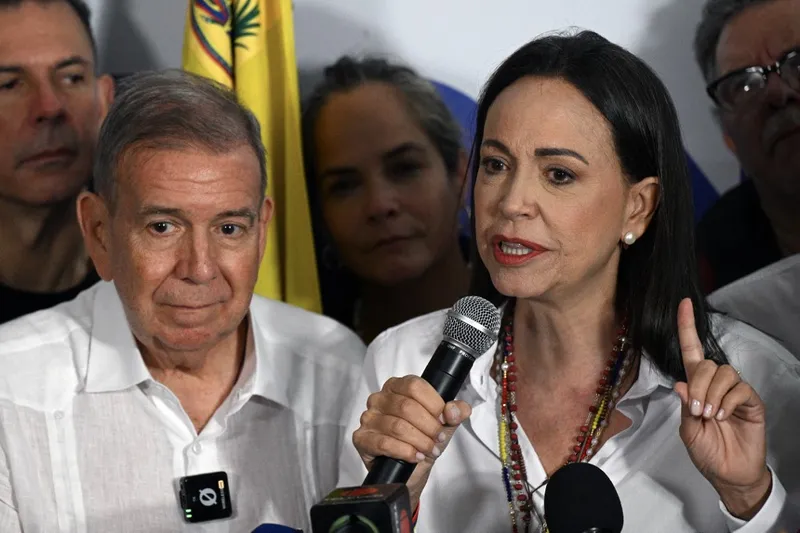
Machado said a group of heavily armed men in civilian clothes seized Juan Pablo Guanipa, 61, in the Los Chorros district of Caracas. The former National Assembly vice president had walked out of jail Sunday as part of a slow-moving wave of political prisoner releases.
The Public Prosecutor’s Office later confirmed Guanipa had been detained for violating the terms of his release and would be placed under house arrest, without providing details. Guanipa’s son Ramon Guanipa demanded proof of life. “He didn’t violate any of the conditions of his release, and we don’t know where he is,” he said.
Guanipa’s arrest sent a chilling message to those pushing for democratic reforms in Venezuela — especially Machado who is pondering a return to her homeland from exile in the United States. Interior Minister Diosdado Cabello, a key figure in the repressive administration of Nicolas Maduro before the leftist president was ousted in a US raid last month, blamed the “stupidity” of the opposition for Guanipa’s fate.
“Nothing happened until the stupidity of some politicians, who thought they could do whatever they wanted and stir up trouble in the country,” Cabello told reporters, claiming Guanipa had violated his parole conditions.
Machado said Guanipa’s detention undermined promises to end decades of repression and de-facto one-party rule, but said she was still determined to return to Venezuela. “This does not affect my return in the slightest. Quite the opposite,” she insisted.
During a few hours of freedom, Guanipa met relatives of political detainees and challenged authorities to respect the results of the 2024 presidential election Maduro is widely accused to have stolen. “You don’t want to respect it? Then let’s go to a (new) electoral process,” Guanipa told AFP on Sunday.
– Winds of change? –
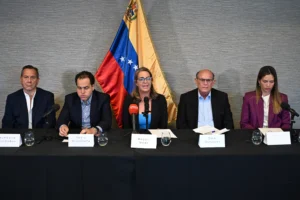
(L-R) Humberto Villalobos, Pedro Urruchurtu, Magallí Meda, Omar González, and Claudia Macero, five Venezuelan opposition figures, (Photo by Alex WROBLEWSKI / AFP) /
Guanipa was first arrested in May 2025 on charges of “terrorism,” money laundering and inciting violence, accusations rights groups say were widely used to silence critics under Maduro. His renewed detention came on the eve of a scheduled vote in Venezuela’s National Assembly to grant amnesty to political dissidents and others.
But Tuesday’s parliamentary sitting was abruptly delayed to Thursday, and it was not known whether the so-called Amnesty Law for Democratic Coexistence would remain on the agenda.
The bill, spearheaded by interim president Delcy Rodriguez, had been hailed as a potential turning point for the South American nation, a month after Maduro was snatched from a Caracas compound and spirited to the United States to face trial.
Rodriguez has tentatively cooperated with Washington since then, promising a slice of Venezuela’s vast oil reserves and a major political opening. Rights group Foro Penal said there have been nearly 400 prisoner releases since Rodriguez took charge.
But reforms have been slow, and much of the military-backed government remains unchanged. Rodriguez herself was a key Maduro defender who had served as his vice president. Rights groups estimate about 700 people are still waiting to be freed.
US congresswoman Maria Elvira Salazar, a close ally of Secretary of State Marco Rubio, said Guanipa must be released immediately. “If anything happens to him, there will be very grave consequences. The United States is watching,” she wrote in a post in Spanish.
Political prisoner Albany Colmenares was among those released to jubilant scenes over the weekend. Flag-waving family and friends cried “freedom” and rushed to hug her as she emerged from Tocuyito prison west of Caracas Sunday.
“Many good things are coming for our country,” Colmenares said. “We will continue to work very hard for that, and we ask you to continue accompanying us.”
