

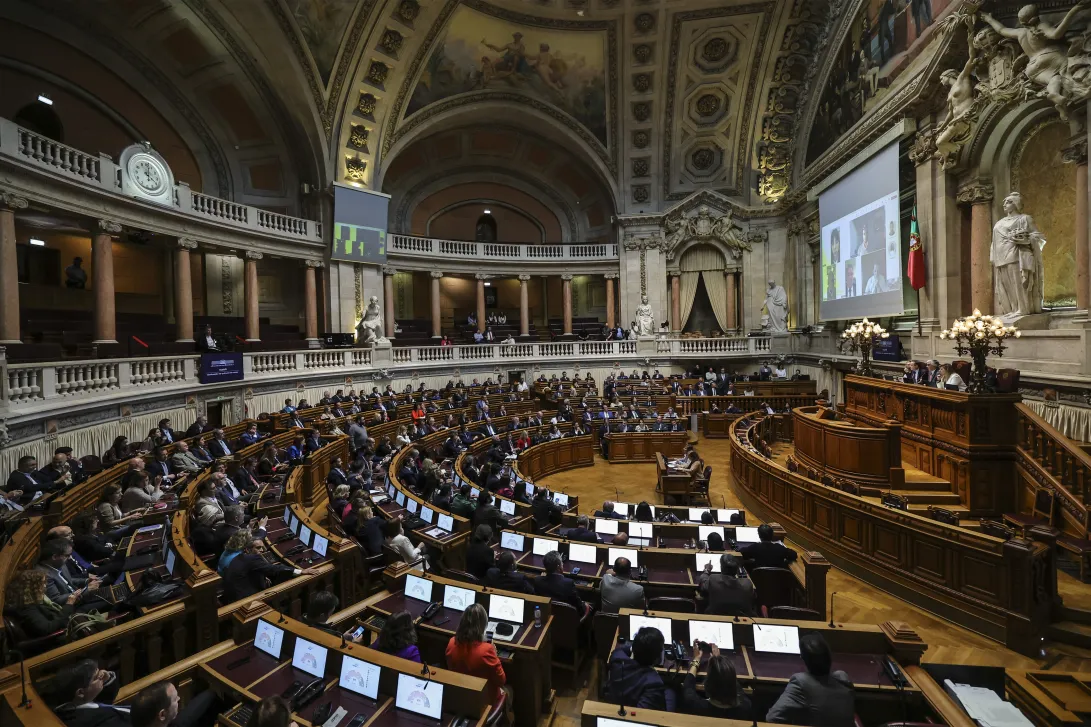
The Liberal group presented two resolution projects to enhance the relationship between the Portuguese State and Taiwan, followed by PAN presenting two other initiatives in the same regard.
In the projects brought to the plenary session of the Assembly of the Republic, both groups highlight the difficulties faced by the approximately 300 Portuguese citizens in Taiwan, who are forced to travel to the consulate in Macau, dependent on Beijing, to address administrative issues, suggesting transferring this responsibility to the embassy in Tokyo.
They also propose the opening of a Portuguese representative office in Taipei to promote economic and cultural relations. In the same debate, the Left Bloc proposed, in another resolution project, that Portugal, “in respect for diplomatic relations… find the most suitable solutions for economic and cultural relations with the territory of Taiwan.”
Chega accordingly presented an initiative recommending that the government mediate to ease tensions between Beijing and Taipei. Rui Rocha of the Liberal Initiative argued that Taiwan “is a consolidated democracy, a strategic economic partner” and a territory with which the European Union is “clearly and assertively deepening relations.”
“It is not asked of the government to recognize Taiwan as a state. It is not requesting a change in Portuguese foreign policy. It merely asks that Portugal acts like a normal European country, protecting its citizens, defending its interests, and not relinquishing its decision-making autonomy out of excessive caution,” commented the Liberal deputy.
Inês Sousa Real from PAN noted that Portugal’s position “is not diplomatic neutrality, it is institutional negligence,” emphasizing that the proposals “are not against anyone,” and calling for “not turning its back on a democracy.”
For PSD, José Cesário, who served as Secretary of State for Communities in various governments, including the first led by Luís Montenegro, argued that the proposals from IL and PAN have “an evident intention to simply ignore the People’s Republic of China,” a “posture that could be considered hostile,” noting the “very deep diplomatic and economic relations” between Lisbon and Beijing.
Moreover, the social democrat argued that the Portuguese State must “safeguard at all costs the interests and security” of the about 130,000 nationals in Macau and Hong Kong.
Regarding the difficulties faced by Portuguese residents in Taiwan, Cesário stated that the government intends to “find administrative solutions in dialogue with Beijing and Taipei.”
“A position like this, I didn’t even expect from the PCP,” criticized Rui Rocha, with the social democrat comparing IL’s position to that of the Left Bloc.
In the same vein, Catarina Louro from PS recalled that Portugal follows the “One China” policy and that predictability “is a diplomatic asset that should not be recklessly or irresponsibly jeopardized.”
In such a volatile international context, abrupt changes, symbolic gestures, or ambiguous political signals can be interpreted as stances within a framework of strategic rivalry among great powers. And it is precisely this that Portugal wants to avoid,” the socialist argued.
Livre, through the voice of Patrícia Gonçalves, proposed the creation of an ad-hoc commission to monitor issues regarding Macau, “to allow for serious, continued, and informed work.”
In this debate, the disagreement among the government coalition partners became evident, with Christian Democrat João Almeida stating that several European countries already have representations in Taipei and “continue to defend the ‘One China’ logic,” adding: “Do not sell us the idea that it is incompatible.”
From Chega, João Ribeiro recalled Portugal’s historical presence in the Far East, asking for the approval of his group’s initiative, “not for adventures, not in the sense of blind alignments, not for empty symbolic gestures,” but to position Portugal “at the service of peace,” promoting “dialogue in a discreet, responsible, and coordinated manner with allies and partners.”
Fabian Figueiredo from the Left Bloc argued that “relations with the territory of Taiwan should be established within the framework of international dialogue based on democratic legality and the diplomatic commitments of the Portuguese State… in a framework that promotes peace, dialogue, opposing any logic of militaristic confrontation, imperial blocs, or provocative adventures.”
From PCP, Alfredo Maia maintained that Taiwan “is an inalienable part” of China and that these proposals “fit into the ongoing campaign of interference and pressure against the People’s Republic of China by the United States, which translates into the exponential increase of tensions and threats.”
Filipe Sousa from JPP expressed support for the initiatives of IL and PAN, arguing that Portugal should assert itself as “an active and pragmatic actor in global economic diplomacy” with a stance close to “countries that share the values of democracy, freedom, and innovation.” The projects will be voted on in plenary next Friday.
Platform with Lusa
