

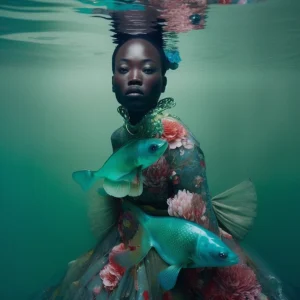
Ting Song, “Tao In One II”, 2023
After receiving high praise in Portugal, “Other Ports – Other Views” is now being shown in China for the first time, beginning its tour in Zhuhai’s The Moment Art Space before moving on to Shenzhen next month and concluding in Macau in 2027. Co-organized by the +853 Cultural Association and Tomorrow’s Heritage, with curators Clara Brito (Macao) and Gu Zhenqing (Beijing), the exhibition features over twenty works that reflect on the role of women in society and culture, responding to contemporary feminist thought through the lens of identity and cultural transformation.
The show presents works by five female artists — Mina Ao, Margarida Gouveia, Ting Song, Xing Danwen, and O Zhang. Among them, Ting Song stands out as a pioneer of digital art, blending AI, blockchain, and traditional aesthetics to explore the intersection between technology and female identity. Brito explains that Ting Song’s digital work was chosen partly to provoke reflection on how data and bias shape perceptions of women.
“If we want to challenge fixed ideas about women, the internet plays a crucial role. Who is feeding the data online? Who — in terms of culture, class, geography, or gender — uploads most of the content that trains AI systems? If inequality exists in that process, the results will inevitably reflect it. That was one of the main reasons these works were selected,” Brito told PLATAFORMA.
Mina Ao, Margarida Gouveia, and Xing Danwen explore forms of symbolic and material violence, offering deeply personal reflections on autonomy and identity, while O Zhang documents the legacy of China’s adoption policies, raising questions about belonging, cultural exchange, and womanhood.
Brito emphasizes that the goal of the exhibition is not confrontation but awareness. She notes that women often face lower pay and greater exposure to violence — not only in the art world but across many fields.
“Let’s talk about these things together,” she says. “This isn’t only a women’s issue. It’s also about how men can participate in building a more balanced world.”
Cultural Exchange
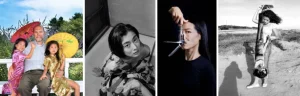
O Zhang, Daddy&I, 2006;Xing Danwen, I am a Woman,1994-1996;Mina Ao,”Right To Exist,Duckbill, steel” 2014;Margarida Gouveia, It Doesn’t Move (From left to right)
How does the same artwork spark different conversations in different cities? Brito says she has no fixed expectations — her aim is to inspire dialogue and mutual understanding.
“For example, in Portugal or other Portuguese-speaking countries, there isn’t much familiarity with Chinese or Macanese culture, which makes it fascinating. Some of the works by artists from Macau and mainland China have sparked curiosity because they’re so distinctive,” she observes.
She adds that this touring exhibition isn’t just about maintaining old partnerships but about reaching new audiences. Having lived in Zhuhai for several years, Brito hopes art can help deepen cultural exchange between China and Portuguese-speaking countries.
“We’ve always seen this connection between Macau, mainland China, and the Lusophone world. Being Portuguese, but also a Macau citizen after more than 20 years here, I feel that’s part of our role,” she says.
Since 2011, Brito has been bringing exhibitions to cities such as Zhuhai, Shenzhen, Shanghai, and Beijing. “It’s been our practice not only to present our own work or that of other artists in China but also to bring contemporary Chinese artists to Macau and to Portuguese-speaking countries. That’s been our mission for the past 10 to 15 years.”
“Other Ports – Other Views” will be shown in Shenzhen at the end of November. Brito notes that Zhuhai and Shenzhen have different atmospheres and audiences, and she’s observed how the Greater Bay Area has evolved in recent years, with increasing exchanges and collaborations: “People move across borders more easily now and are more connected within the GBA.”
Though deeply connected to Macau, Brito believes it’s essential to step outside one’s comfort zone and bring local creations to wider audiences.
“We’re a mixed team — Portuguese, Chinese, and Macanese. For us, it’s important to act as cultural ambassadors, representing Macau’s role in bridging China and the Portuguese-speaking world.”
